
LIFE INSURANCE GUIDE
Whole Life vs. Universal Life Insurance
Short answer: Whole life and universal life are both permanent life insurance, so they can cover you for life. Whole life offers fixed premiums and guaranteed values, with less flexibility. Universal life separates the cost of insurance from an investment account, offering flexible premiums and investment choices, but you carry more of the risk.
Quick facts
- Both whole life and universal life are permanent policies that can last for your whole life.
- Whole life usually has fixed premiums and guaranteed cash values set in the contract.
- Participating whole life can also pay policy dividends, which are not guaranteed.
- Universal life lets you adjust premiums within limits and choose how the savings account is invested.
- Growth inside either policy is generally tax-sheltered as long as the policy stays within the exempt policy rules in the Income Tax Act.
In this guide: What do whole life and universal life have in common? · Whole life vs. universal life at a glance · How whole life insurance works · How universal life insurance works · Flexibility versus predictability · Taxes and accessing the cash value · How to choose between them · FAQ

Whole life and universal life insurance are the two main types of permanent life insurance in Canada. Both can stay in force for your entire life and both can build cash value. The differences are in how premiums work, what is guaranteed, how the savings component is managed and who carries the investment risk. This guide sets them side by side so you can see which features matter for your situation.
What do whole life and universal life have in common?
- Coverage can last for life, as long as the policy remains in force.
- Both can build a cash value you may be able to access.
- Growth inside the policy is generally not taxed each year while the policy meets the exempt policy rules.
- The death benefit paid to a named beneficiary is generally tax-free.
- Both usually cost more than term life insurance for the same death benefit, because they are built to last.
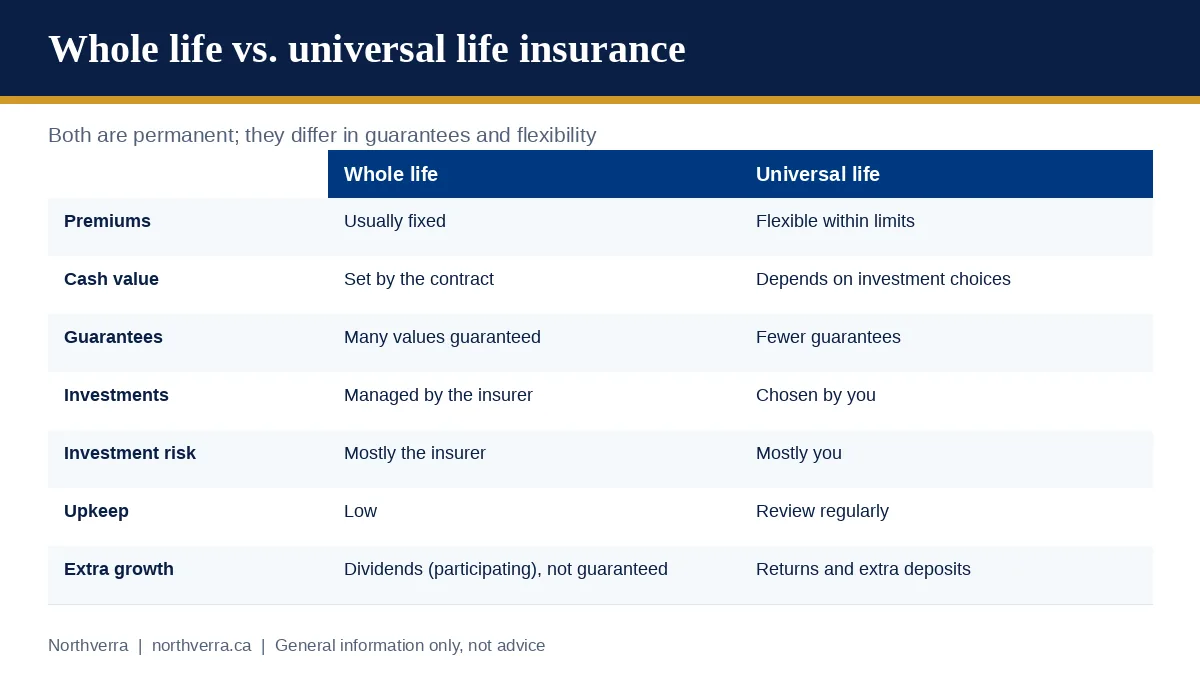
Whole life vs. universal life at a glance
| Feature | Whole life | Universal life |
|---|---|---|
| Premiums | Usually fixed for life or for a set payment period | Flexible within minimum and maximum limits |
| Cash value | Grows according to the contract; guaranteed values in many designs | Depends on the investment options you choose and their returns |
| Guarantees | Death benefit, premiums and many cash values are guaranteed | Fewer guarantees; often only the death benefit if the account is funded |
| Investment control | The insurer manages the investments | You choose from the options the insurer offers |
| Who carries the risk | Mostly the insurer | Mostly you |
| Ongoing attention | Low | Moderate: regular reviews are important |
| Extra growth | Participating policies may pay dividends, not guaranteed | Depends on returns and how much you deposit |
How whole life insurance works
With whole life, you pay a premium that is usually fixed when the policy is issued. You may pay for life, or for a shorter period such as 20 years or until age 65. The contract sets out the death benefit and, in many designs, a schedule of guaranteed cash values.
Non-participating and participating whole life
Non-participating whole life has fixed guarantees and no dividends. Participating whole life also shares in the results of the insurer’s participating account through policy dividends. Many owners use dividends to buy paid-up additions, which increase both the death benefit and the cash value over time. Dividends are not guaranteed and depend on factors such as investment returns, claims and expenses.
How universal life insurance works
Universal life separates the policy into two parts: the cost of insurance and fees, and an investment account. Your deposits go into the account, and the cost of insurance is withdrawn from it. Any amount above that grows inside the policy based on the options you choose. Our guide to universal life insurance covers the mechanics in more detail.
Level or rising cost of insurance
Universal life policies usually offer two ways to pay for the insurance itself. A level cost of insurance stays the same for life and is higher at the start. A yearly renewable cost starts lower and rises every year. The rising option can become expensive later, and if the account does not keep up, the policy can lapse.
Flexibility versus predictability
The main trade-off is simple. Whole life gives you predictability: you know the premium, and many values are set in the contract. Universal life gives you flexibility: you can deposit more in good years, pay less in tight years within limits, and choose investments. That flexibility comes with responsibility, because underfunding the account or weak returns can reduce the value of the policy.
Example (hypothetical): Daniel and Priya, both 45, want a permanent policy to help cover taxes on their cottage when it passes to their children. Daniel prefers fixed premiums and guaranteed values, so whole life appeals to him. Priya likes the idea of depositing extra money in years when her business does well, which points to universal life. Their advisor shows both illustrations, including the guaranteed and projected columns, before they decide.
Taxes and accessing the cash value
Both policies can let you access the cash value through withdrawals or policy loans, or by using the policy as collateral. When you take money out, the amount above your adjusted cost basis can be taxable income, and loans or withdrawals reduce what your beneficiaries receive. Growth also has limits: a policy that holds too much savings relative to its insurance can lose its exempt status, so insurers design policies to stay within the rules.
How to choose between them
- Choose whole life if you value fixed costs, guarantees and minimal maintenance.
- Consider universal life if you want flexible deposits and investment choice, and you are comfortable reviewing the policy regularly.
- Consider whether you need permanent coverage at all. Many families cover most of their need with term insurance and use a smaller permanent policy for lifelong goals. See term vs. whole life insurance.
- Ask to see the guaranteed values separately from the projections, and understand the assumptions behind any projection.
Key takeaways
- Whole life trades flexibility for predictability.
- Universal life trades predictability for flexibility and investment choice.
- With universal life, you need to monitor the account so the policy does not run short.
- Taking money out of either policy can create taxable income above your adjusted cost basis.
- Many people only need permanent coverage for part of their total insurance; term insurance often covers the rest.
Who this guide is for
- People who want coverage that lasts for life, for example to cover estate taxes or leave a legacy.
- Business owners using insurance in their company’s plans.
- Households that have used their RRSP and TFSA room and want another tax-sheltered option.
- Anyone comparing quotes for both policy types.
Questions to ask an insurance advisor
- Which values in this policy are guaranteed, and which are projections?
- What happens to my coverage if I pay less, or skip a premium?
- For universal life, is the cost of insurance level or does it rise each year?
- How can I access the cash value, and what are the tax effects?
- What fees or surrender charges apply in the early years?
Frequently asked questions
Which costs more, whole life or universal life?
It depends on the design. Whole life premiums are often higher at the start because they are fixed for life and include guaranteed values. Universal life can start lower, especially with a cost of insurance that rises each year, but costs can increase later. Comparing illustrations side by side, including guaranteed and projected values, is the clearest way to see the difference.
Is whole life insurance a good investment?
Whole life is first an insurance contract. Its cash value grows in a steady, conservative way and is tax-sheltered within limits, but it is not designed to compete with market investments on returns. For some people, its value comes from the combination of lifelong coverage, stability and estate benefits.
Can universal life insurance lapse?
Yes. If the account value is not enough to cover the cost of insurance and fees, the policy can lapse unless you add money. This is more likely when premiums are reduced, investment returns are weak, or the cost of insurance rises with age. Reviewing the policy every year or two helps avoid surprises.
What are participating whole life dividends?
Participating policies share in the results of the insurer’s participating account. Dividends can be used to buy extra paid-up insurance, reduce premiums, be taken as cash or left on deposit. They are not guaranteed and can change. Our guide to participating whole life insurance explains the options.
Can I switch from universal life to whole life?
Usually not directly. You would normally apply for a new policy, which means new underwriting and new costs. Before replacing any permanent policy, compare what you would give up, such as surrender charges and existing guarantees.
How do I get money out of a permanent life insurance policy?
Common methods are withdrawals from the cash value, policy loans from the insurer, or using the policy as collateral for a bank loan. Each can reduce the death benefit and some may create taxable income. See using life insurance as collateral.
Is permanent life insurance better than buy term and invest the difference?
Neither is right for everyone. Buying term and investing the difference can work well if you invest consistently and do not need lifelong coverage. Permanent insurance can make sense when the need lasts for life or when you value guarantees and tax-sheltered growth after using other registered accounts.
Do whole life and universal life pay a tax-free death benefit?
In general, yes. The death benefit paid to a named beneficiary is generally not taxable income. For universal life, the payout may include the account value depending on the death benefit option you chose.
Last updated: October 11, 2026
Related guides
- What is universal life insurance?
- What is participating whole life insurance?
- What is cash value life insurance?
- Term vs. whole life insurance: Which is better?
- Term Life Insurance in Canada
- All life insurance questions, answered
Talk it through with us
Every situation is different. If you would like to talk about how this applies to you, we are happy to walk through your questions with no obligation.
Have a question? Start a conversation
Tell us a little about your situation. We will reply within one business day.
By submitting this form you agree that Northverra may contact you about your enquiry. Please do not include account numbers, health details or other sensitive information. See our Privacy Policy.
Important information. Life insurance products are subject to underwriting, eligibility, exclusions, limitations and the terms of the policy contract. Coverage, premiums and availability depend on your age, health, lifestyle and other factors. Nothing on this page is an offer of insurance or a guarantee of coverage or price. See our Disclosures.
Important information. The information on this page is general in nature, is provided for educational purposes only, and is not personalized financial, insurance, legal, tax or mortgage advice. Your circumstances are unique. Please speak with a properly licensed professional before making decisions. See our Disclosures.