
INVESTMENT QUESTIONS
What is the best approach to investing in your 30s?
Short answer: Investing in your 30s usually means balancing several goals at once: an emergency fund, paying down high-interest debt, saving for a home, an RESP if you have children and steady retirement savings. Time is on your side for long-term goals, so many people hold more growth investments for retirement while keeping short-term money safe. The key is to rank goals, use the right accounts and automate.
In this guide: Why your 30s matter so much · A sample order of priorities · Choosing between TFSA and RRSP in your 30s · Matching investments to each goal · Protection is part of investing · Habits that make the biggest difference · Common mistakes in your 30s · Questions to ask yourself · Building a simple system · FAQ

Your 30s can be the busiest financial decade. Career progress, a first home, a partner, children and student loans can all arrive at once. Investing in your 30s in Canada is less about finding the perfect investment and more about getting the order of priorities right and building habits that last. This guide offers a practical framework, with the questions and checklists to help you apply it.
Why your 30s matter so much
For long-term goals like retirement, money invested in your 30s has decades to potentially grow. Our compound growth explained article shows why starting earlier can make a large difference over time, though growth is never guaranteed. At the same time, this decade is full of shorter-term goals that need safer money, so the challenge is balance.
A sample order of priorities
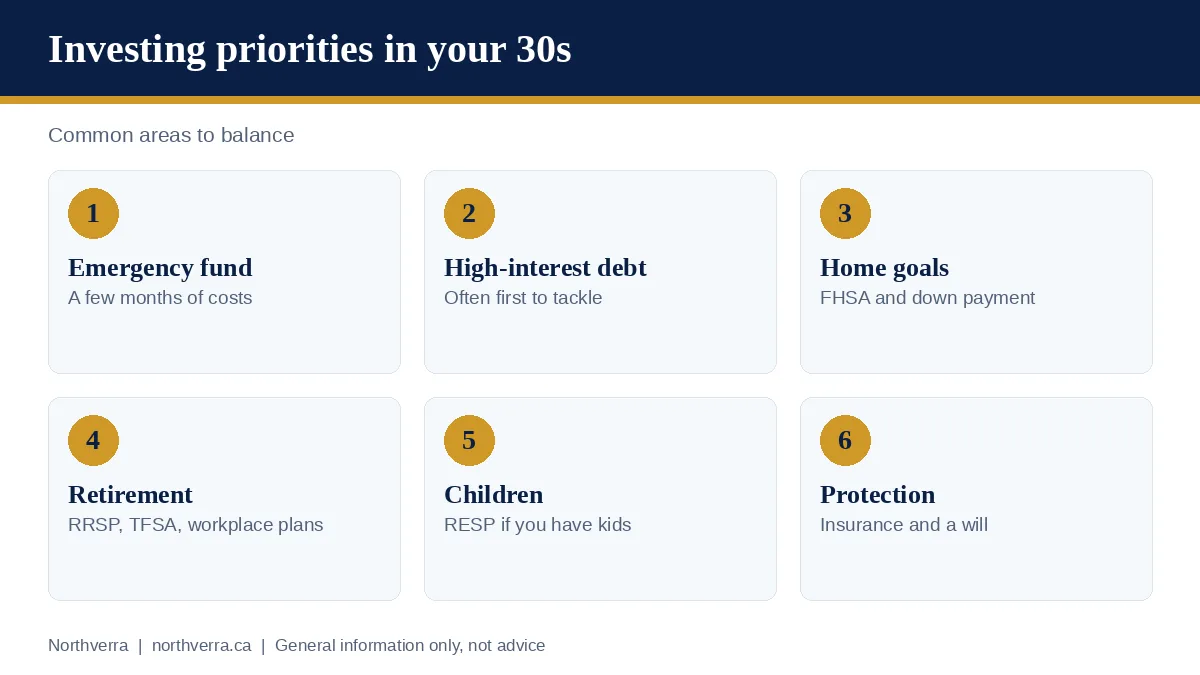
Every household is different, but many people work through something like this:
- Emergency fund: savings to cover a few months of essential expenses. See building an emergency fund.
- High-interest debt: credit cards and similar balances. See debt repayment vs investing.
- Employer match: if your workplace offers a group RRSP or pension match, contribute enough to get it.
- Home savings: if you are an eligible first-time buyer, an FHSA can be a strong option.
- Children’s education: an RESP to collect government grants.
- Retirement: TFSA and RRSP contributions for the long term.
- Protection: life and disability insurance and a will, so one event does not undo the plan.
You may work on several at once, splitting a monthly amount between them. See how much to invest each month.
Choosing between TFSA and RRSP in your 30s
If your income is moderate today and likely to rise, a TFSA may be attractive now, with RRSP contributions becoming more valuable as your tax rate climbs. If you are already in a higher bracket, RRSP deductions may be more useful. Many people use both. Our RRSP vs TFSA basics guide explains the differences. Unused RRSP deduction room carries forward, so you can make contributions in a higher-income year.
Matching investments to each goal
- Emergency fund and home down payment: savings accounts, GICs or other stable options, because the timeline is short.
- RESP: often more growth while children are young, becoming more conservative as school approaches.
- Retirement: with 25 to 35 years to go, many hold a larger share of diversified stock funds, if they can tolerate the swings.
See asset allocation by age for how this changes over time.
Example (hypothetical): Sara and Ben, both 34, have one child and a mortgage. They keep three months of expenses in a high-interest savings account, contribute enough to their group RRSPs to receive the employer match, put $2,500 a year into an RESP to capture the basic grant and split the rest between TFSAs. The figures are illustrative; the right split depends on each family.
Protection is part of investing
Your ability to earn income is likely your largest financial asset in your 30s. If a young family depends on that income, life and disability insurance protect the plan you are building. Our guides on how much life insurance you may need and insurance and wealth building explain how protection fits.
Habits that make the biggest difference
- Automate contributions on payday so investing happens first.
- Increase contributions with each raise.
- Keep fees low and investments diversified.
- Track your net worth once or twice a year.
- Review the plan when life changes: a new job, a move, a child or a separation.
Common mistakes in your 30s
- Pausing retirement savings for years while focusing only on the home.
- Lifestyle creep, where spending rises to match every raise.
- Holding home down payment money in volatile investments.
- Skipping insurance and a will after having children.
- Following investment trends on social media instead of a plan.
Questions to ask yourself
- Which goals matter most in the next five years, and which can wait?
- Am I getting every employer match and government grant available to me?
- Is my short-term money in stable places?
- Would my family be secure if my income stopped?
Building a simple system
In a busy decade, a simple system works better than a complicated one. Many people in their 30s settle on a few accounts with clear jobs: a high-interest savings account for emergencies, an FHSA or TFSA for the home, an RESP for the children and an RRSP or workplace plan for retirement. Each gets an automatic contribution on payday. Once a year, review the amounts, increase them if your income has risen and rebalance if needed. A system like this takes little time to run, which makes it far more likely to last through the changes that this decade tends to bring.
Next step
Juggling a home, family and retirement goals? We can help you rank priorities and build a plan you can stick with.
More questions people ask
Is it too late to start investing in my 30s?
No. Many people begin in their 30s. Starting with a clear plan and regular contributions can still make a meaningful difference.
Should I pay off my mortgage or invest in my 30s?
It depends on your rate, your other goals and your comfort with risk. Many people do some of both. See debt repayment vs investing.
How much should I have saved by 35?
There is no official target. Rules of thumb exist, but your needs depend on income, pensions and goals. Focus on a plan that fits you.
Should I invest in my child’s RESP or my own retirement?
Many families do both. The RESP grant is valuable, but your own retirement has no grants or loans to fall back on, so it should not be neglected.
Related guides
Have a question? Start a conversation
Tell us a little about your situation. We will reply within one business day.
By submitting this form you agree that Northverra may contact you about your enquiry. Please do not include account numbers, health details or other sensitive information. See our Privacy Policy.
Important information. Investing involves risk, including the possible loss of the amount invested. The value of investments can go down as well as up, and past performance does not guarantee future results. Nothing on this page is a recommendation or a promise of any return. Diversification and asset allocation do not ensure a profit or protect against loss. See our Disclosures.