
MORTGAGE QUESTIONS
What are closing costs in Alberta?
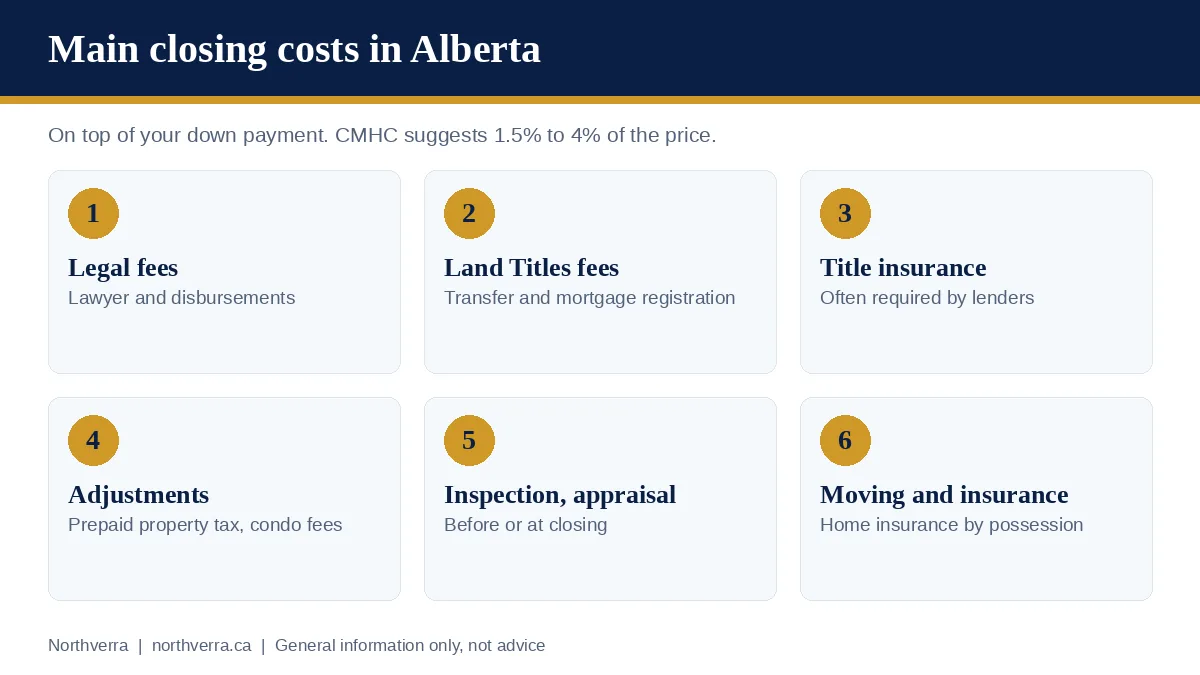
Short answer: Closing costs in Alberta are the one-time expenses you pay when a home purchase completes, on top of your down payment. They usually include legal fees, title insurance, Land Titles registration fees for the transfer and the mortgage, property tax and utility adjustments, and sometimes GST on new homes. Alberta has no land transfer tax, but CMHC suggests budgeting about 1.5% to 4% of the price.
In this guide: What closing costs usually include · Alberta Land Titles fees · A hypothetical closing budget · Costs that depend on your mortgage · Condo purchases · How to prepare for closing day · Common mistakes to avoid · New construction and GST · Setting aside a buffer after closing · FAQ

Closing costs in Alberta surprise many first-time buyers because they arrive at the very end, after the down payment is already set aside. Alberta is one of the few provinces without a land transfer tax, which keeps costs lower than in some other provinces, but there are still several fees to plan for. Knowing what to expect lets you arrive at closing day without a scramble.
What closing costs usually include
Every purchase is different, and your lawyer will give you a statement of adjustments with the final figures. Common items include:
- Legal fees and disbursements: a real estate lawyer handles the transfer of title, registers the mortgage, holds funds in trust and reviews documents. Fees vary by firm and by the complexity of the deal.
- Land Titles registration fees: Alberta charges fees to register the transfer of land and the mortgage.
- Title insurance: many lenders require it. It protects against certain title problems and fraud and is usually a one-time premium.
- Property tax and utility adjustments: if the seller has prepaid property taxes or condo fees beyond the possession date, you reimburse them for your share.
- Home inspection and appraisal: an inspection is usually paid before closing, and some lenders charge for an appraisal.
- Real property report or survey items: often provided by the seller in Alberta, but check your purchase contract.
- Moving, utility connections and home insurance: lenders require property insurance to be in place by possession.
- GST on new homes: new construction and substantially renovated homes may be subject to GST, which can be included in the price or added, and rebates may apply.
Alberta Land Titles fees
Instead of a land transfer tax, Alberta charges registration fees. According to the Government of Alberta, both the transfer of land and the mortgage registration are charged a base fee of $50 plus $5 for every $5,000 (or part of $5,000) of value: the property value for the transfer and the principal amount for the mortgage. These fees are set by regulation and can change, so your lawyer will confirm the current amounts.
A hypothetical closing budget
Example (hypothetical): Sam buys a $500,000 home in Calgary with a $450,000 mortgage. Using the published formula, the transfer registration is about $550 ($50 plus 100 x $5) and the mortgage registration about $500 ($50 plus 90 x $5). Sam also budgets for legal fees and disbursements, title insurance, a home inspection, a property tax adjustment and moving costs. Together these could reasonably come to several thousand dollars. Sam sets aside about 1.5% of the price, or $7,500, and keeps his emergency fund separate. All figures are hypothetical; actual fees depend on the lawyer, the property and the date.
Costs that depend on your mortgage
- Mortgage default insurance: if you have less than 20% down, the premium is usually added to your mortgage. Alberta has no provincial sales tax, so there is no sales tax on the premium here. See CMHC mortgage insurance.
- Interest adjustment: some lenders charge interest from the closing date to the start of your regular payment cycle.
- Penalties on an existing mortgage if you are selling one home and buying another. Our guide to mortgage prepayment penalties explains how they are calculated.
Condo purchases
For condos, expect your lawyer or realtor to review the condo documents, and budget for any document fees, a possible move-in fee and an adjustment for condo fees. A special assessment that has been approved but not yet paid should be clarified in your purchase contract.
How to prepare for closing day
- Ask for a quote from your lawyer early, including disbursements.
- Confirm with your lender which costs, such as appraisals or title insurance, they require.
- Arrange home insurance before your possession date.
- Keep the closing funds in an account you can access quickly, and be ready to provide them to your lawyer in the required form a few days before closing.
- Build in a buffer for unexpected adjustments.
Our first-time home buyer checklist for Alberta places closing costs in the wider buying process, and our guide to the minimum down payment explains how to plan both amounts together.
Common mistakes to avoid
- Assuming there are no closing costs because Alberta has no land transfer tax.
- Spending closing funds on furniture before possession.
- Forgetting the property tax adjustment when the seller has prepaid the year.
- Leaving home insurance until the last minute.
- Not budgeting for immediate repairs found during the inspection.
New construction and GST
If you buy a newly built home, or a home that has been substantially renovated, GST may apply. Builders often quote prices that already include GST net of any rebate the buyer assigns to them, but this is not always the case. Read the purchase agreement carefully, ask whether the price is GST-inclusive and ask your lawyer which rebates you may be eligible for. Federal rebates for new homes have changed in recent years and have specific eligibility conditions, including rules for first-time buyers, so confirm the current rules with the Canada Revenue Agency rather than relying on a builder’s summary. Deposits on new builds are often paid in instalments, so plan for those cash needs as well as closing.
Setting aside a buffer after closing
The first months in a new home bring costs that are not on any statement of adjustments: window coverings, tools, a lawn mower, small repairs and sometimes appliances. Keeping a separate cushion for these, rather than using your emergency fund, helps you settle in without putting new purchases on high-interest credit.
Next step
If you are building a full budget for a purchase, we can help you estimate the down payment, closing costs and a cushion so closing day is calm.
More questions people ask
Does Alberta have a land transfer tax?
No. Alberta charges Land Titles registration fees for the transfer and the mortgage instead, which are generally lower than land transfer taxes in some other provinces.
Can closing costs be added to my mortgage?
Generally not. Lenders expect you to have closing costs in cash, although default insurance premiums are usually added to the mortgage.
Who pays for the real property report?
In many Alberta transactions the seller provides it, but it depends on your purchase contract. Your realtor and lawyer can confirm.
How long before closing do I need the money?
Your lawyer will tell you, often a few days before the possession date, so funds can clear in trust.
Related guides
Have a question? Start a conversation
Tell us a little about your situation. We will reply within one business day.
By submitting this form you agree that Northverra may contact you about your enquiry. Please do not include account numbers, health details or other sensitive information. See our Privacy Policy.
Important information. Mortgage approval, interest rates, terms and eligibility depend on the lender, your financial profile, the property and current market conditions, and are not guaranteed. Mortgage products and rates change. Nothing on this page is a commitment to lend or a quote of any rate. See our Disclosures.