
MORTGAGE QUESTIONS
Mortgage broker vs bank: which should I use?
Short answer: A bank offers its own mortgage products through its own staff, while a mortgage broker compares products from several lenders, which can include banks, credit unions, monoline lenders and alternative lenders. Neither is always better. A bank can suit people who value an existing relationship and bundled banking, while a broker can suit people who want to compare options in one place or whose situation is less typical.
In this guide: How getting a mortgage through a bank works · How getting a mortgage through a broker works · How each one is paid · Comparing on what matters · Questions to ask either one · Common mistakes to avoid · What to bring, whichever you choose · Getting the best from either option · FAQ

The mortgage broker vs bank question comes up early for most buyers. Both can arrange a mortgage, both must follow lending rules and both are paid for their work in some way. The differences are in how many lenders you can access, who the person works for and how the service fits your situation. This guide explains how each one works so you can choose with confidence.
How getting a mortgage through a bank works
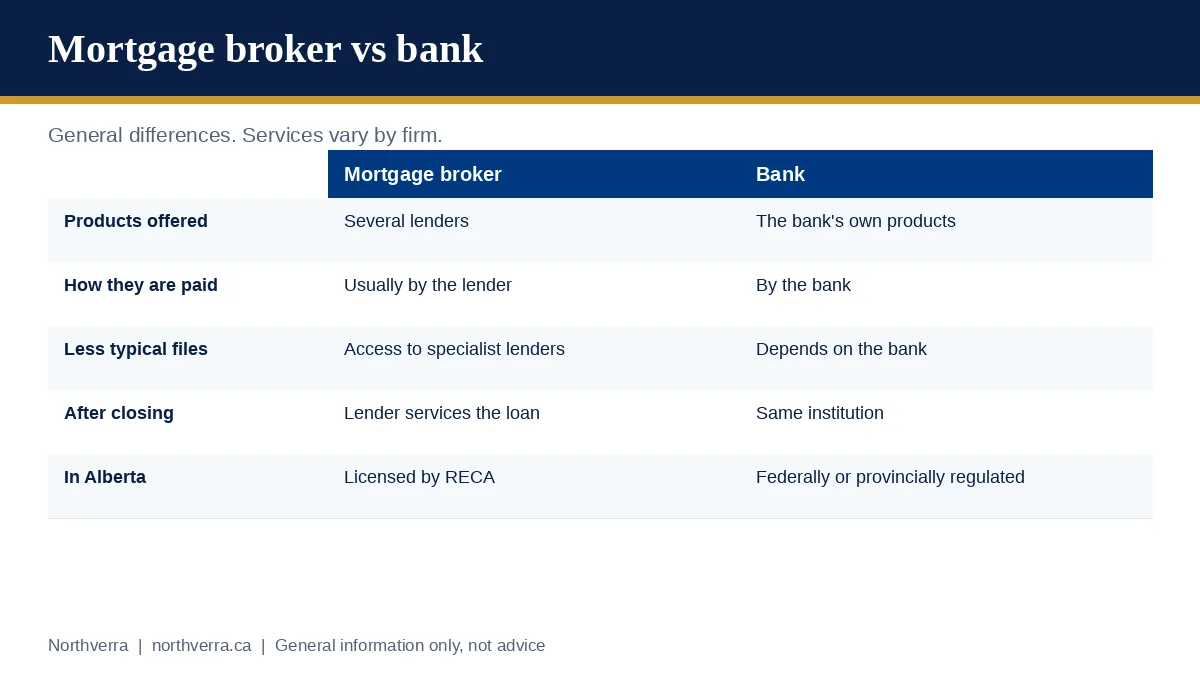
When you go to a bank or credit union, a mortgage specialist offers that institution’s own products. You may benefit from an existing relationship, the convenience of having your accounts and mortgage in one place and, in some cases, bundled offers. The specialist can usually only offer what that one lender has, and the posted rates may be a starting point for negotiation. Some banks also have mobile mortgage specialists who meet you at home.
How getting a mortgage through a broker works
A mortgage broker is licensed in their province to arrange mortgages. In Alberta, mortgage brokers are licensed by the Real Estate Council of Alberta (RECA). A broker gathers your information and documents once, then compares offers from the lenders they work with. These can include large banks, credit unions, monoline lenders that only offer mortgages, and alternative or private lenders for less typical situations. You can check a broker’s licence on the regulator’s public register.
How each one is paid
- Bank specialists are paid by the bank, sometimes partly through commissions or incentives.
- Mortgage brokers are usually paid a finder’s fee by the lender when the mortgage closes, so for most standard residential mortgages the borrower does not pay the broker directly. For some alternative or private mortgages, a broker fee may be charged to the borrower.
Ask either one how they are paid and whether any fee applies to you. Brokers are generally required to disclose how they are compensated and any conflicts of interest.
Comparing on what matters
Choice of products
A broker can compare several lenders at once, which can help you find a mix of rate, prepayment privileges, penalty rules and portability that suits you. A bank offers its own product range, which may be enough if it fits your needs.
Rates
Brokers often have access to discounted rates from multiple lenders. Banks may match or beat those, especially for existing clients. Always compare the full offer, not only the rate, including the penalty calculation, which can vary a lot between lenders. Our guide to mortgage prepayment penalties explains why.
Less typical situations
If you are self-employed, have a recent credit issue, are new to Canada or are buying an unusual property, a broker may be able to point you to lenders that specialize in your situation. See our guide to self-employed mortgages.
Relationship and service
A bank relationship can be valuable if you also want other services, such as a line of credit, from the same place. With a broker, your day-to-day servicing after closing is handled by the lender, but the broker may help again at renewal.
Example (hypothetical): Tom banks with a large bank and asks for a pre-approval there. He also speaks with a broker, who compares several lenders. The broker’s best offer has a slightly lower rate but stricter prepayment terms, while his bank offers a rate close to it with more flexible privileges. Tom chooses based on the features he is likely to use, not on the rate alone. This is a hypothetical example.
Questions to ask either one
- Which lenders or products can you offer me?
- How are you paid, and will I pay any fee?
- How is the prepayment penalty calculated on this mortgage?
- What are the prepayment privileges and portability terms?
- How long is the rate hold, and what happens if rates fall?
- Who services the mortgage after closing, and who will help me at renewal?
Common mistakes to avoid
- Choosing on rate alone without comparing the penalty and flexibility.
- Assuming a bank cannot negotiate, or that a broker always finds the lowest rate.
- Applying everywhere at once without keeping the credit checks in a short window.
- Not checking a broker’s licence with the provincial regulator.
- Signing for an alternative or private mortgage without understanding all of the fees.
What to bring, whichever you choose
You will save time with either a bank or a broker if you arrive prepared. Bring recent pay stubs and an employment letter, two years of Notices of Assessment, statements showing your down payment, details of any debts and, if you own property, your current mortgage statement and property tax bill. Self-employed borrowers should add two years of tax returns and business financial statements. Knowing your own budget before the meeting is just as important; our guide to how much mortgage you can afford can help you set it.
Getting the best from either option
Whether you work with a bank or a broker, the outcome improves when you ask for offers in writing, compare them side by side and do not feel rushed. A good mortgage professional should explain why an offer suits you, not just how low the rate is. They should also be willing to answer questions about penalties, portability and renewal before you commit. If anything feels unclear or pressured, it is reasonable to pause and get a second opinion. The decision affects your finances for years, so taking an extra few days to compare is usually time well spent.
Next step
Whichever route you choose, we can help you understand the offers you receive, compare the features that matter and prepare for a mortgage pre-approval.
More questions people ask
Do mortgage brokers charge fees?
For most standard residential mortgages, the lender pays the broker. Fees to the borrower are more common for alternative or private mortgages and must be disclosed.
Do brokers get better rates than banks?
Sometimes, because they can compare several lenders. Banks may also offer competitive rates, especially to existing clients. Compare offers in writing.
Can I use a broker and still get a bank mortgage?
Yes. Many brokers work with some banks, along with credit unions and monoline lenders.
Who regulates mortgage brokers in Alberta?
Mortgage brokers in Alberta are licensed and regulated by the Real Estate Council of Alberta (RECA).
Related guides
Have a question? Start a conversation
Tell us a little about your situation. We will reply within one business day.
By submitting this form you agree that Northverra may contact you about your enquiry. Please do not include account numbers, health details or other sensitive information. See our Privacy Policy.
Important information. Mortgage approval, interest rates, terms and eligibility depend on the lender, your financial profile, the property and current market conditions, and are not guaranteed. Mortgage products and rates change. Nothing on this page is a commitment to lend or a quote of any rate. See our Disclosures.