
MORTGAGE QUESTIONS
Can I get a self-employed mortgage in Canada?
Short answer: Yes, self-employed Canadians can get a mortgage, but lenders usually need more proof of income, most often two years of personal tax returns and Notices of Assessment, plus business financial statements. Lenders generally rely on the income you report for tax, so large write-offs can lower what you qualify for. Planning a year or two ahead makes a self-employed mortgage much easier to arrange.
In this guide: How lenders look at self-employed income · Documents to prepare · Options if your reported income is low · Plan a year or two ahead · Strengthen your file · Protect your income too · Common mistakes to avoid · Renewing and refinancing as a self-employed borrower · FAQ

A self-employed mortgage follows the same basic rules as any other: lenders want to see stable income, manageable debts, a down payment and good credit. The difference is how you prove your income. Business owners, contractors, commissioned salespeople and gig workers often have income that varies, comes from several sources or is reduced on paper by legitimate expenses. Understanding how lenders look at it lets you prepare well ahead of time.
How lenders look at self-employed income
Most lenders start with the income on your personal tax return and Notice of Assessment, often averaging the last two years. If your income has grown, some lenders may use the most recent year; if it has fallen, they may use the lower figure. For incorporated business owners, lenders may consider salary and dividends you pay yourself and, in some cases, a share of the company’s retained earnings. Each lender has its own approach.
The challenge for many business owners is that deductions reduce taxable income. A contractor who writes off a vehicle, a home office and equipment may have a healthy business but a modest net income on paper. Some lenders allow certain non-cash expenses, such as capital cost allowance, to be added back. Others do not.
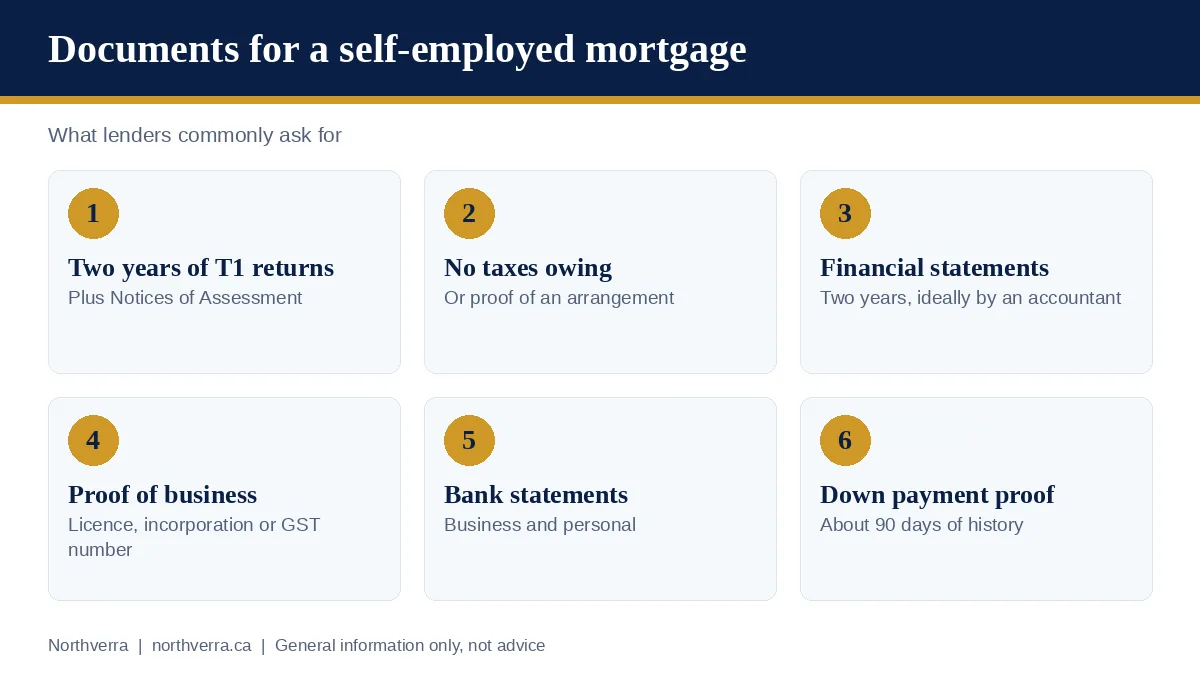
Documents to prepare
- Two years of personal T1 General tax returns and Notices of Assessment.
- Proof that there are no taxes owing to the CRA, or that balances are under an arrangement.
- Business financial statements for two years, ideally prepared by an accountant, and corporate tax returns if you are incorporated.
- Your business licence, articles of incorporation or GST/HST registration, to show how long you have operated.
- Business and personal bank statements, which can support income and the down payment.
- Contracts or invoices showing ongoing work, especially if you are newer to self-employment.
Options if your reported income is low
Insured mortgages for self-employed borrowers
Some mortgage insurance programs allow self-employed borrowers with a shorter history or less traditional documents to qualify, with conditions. Your lender or mortgage professional can tell you what is currently available.
Stated income or alternative lenders
Some lenders, often called alternative or “B” lenders, will consider income that is reasonable for your industry and supported by bank statements, even when it is higher than your taxable income. These mortgages usually need a larger down payment and come with higher rates and fees. They are often used as a short-term bridge while you build your tax history, with a plan to move to a standard lender later.
Private lenders
Private lenders focus mostly on the property’s value and charge significantly higher rates and fees. They are generally a last resort for short periods.
Example (hypothetical): Raj has run his own landscaping company for three years. His business is profitable, but after expenses his personal income was $58,000 and $64,000 in the last two years. A standard lender averages these to $61,000, which supports a smaller mortgage than he hoped. His accountant points out that some vehicle depreciation could be added back by certain lenders, and his mortgage professional finds a lender that accepts this. Raj also plans to report more income next year so he can qualify for more at renewal. This is a hypothetical example, not tax advice.
Plan a year or two ahead
If you expect to buy, talk with your accountant and a mortgage professional before you file your taxes. Reporting more income may mean paying more tax, but it could also improve your borrowing power. There is a balance, and it depends on your goals. Keep your personal and business finances separate, pay your taxes on time, and avoid large new debts in the year before you apply. Our article on understanding your credit score explains how to look after your credit file.
Strengthen your file
- Save a larger down payment; it lowers the lender’s risk and widens your options. See the minimum down payment in Canada.
- Keep your credit utilization low on both personal and business cards.
- Get a mortgage pre-approval early so you know where you stand.
- Consider a co-borrower with employment income, understanding the shared responsibility.
- Work with someone who regularly arranges self-employed mortgages; see mortgage broker vs bank.
Protect your income too
When your household depends on your business, it is worth thinking about what would happen to the mortgage if you could not work. Our page on how business owners can use life insurance covers one part of that planning.
Common mistakes to avoid
- Applying right after a year with very low reported income.
- Mixing personal and business spending in the same account.
- Owing taxes to the CRA when you apply.
- Assuming an alternative lender is a permanent solution.
- Waiting until you find a home to gather documents.
Renewing and refinancing as a self-employed borrower
The same documents come up again when you refinance or move to a new lender, so keep your tax returns, Notices of Assessment and financial statements organized each year. Renewing with your current lender usually does not require full requalification, but switching lenders or borrowing more generally does. If your income has grown since you bought, renewal can be a good time to move from an alternative lender to a standard one, which may lower your rate and fees.
Mortgage options for self-employed Canadians at a glance
| Option | Who it often suits | Trade-offs |
|---|---|---|
| Traditional lender, full documentation | Owners with two or more years of steady reported income | Usually the most competitive rates; most paperwork |
| Insured mortgage with less than 20% down | Owners who meet insurer requirements for self-employed income | Insurance premium; documentation still required |
| Alternative lender | Owners whose reported income is low because of write-offs, or with a shorter history | Higher rates and fees; often larger down payment |
| Private lender | Short-term or unusual situations | Highest rates and fees; usually a short-term solution |
| Co-signer | Owners who need extra income to qualify | The co-signer shares responsibility for the debt |
Incorporated owners versus sole proprietors
If you run your business as a sole proprietor, lenders usually look at the income on your personal tax returns after expenses. If you are incorporated, lenders look at the salary and dividends you pay yourself, and some may also consider the company’s financial statements and retained earnings. How you pay yourself can affect how much you qualify for, which is why planning a year or two ahead helps. See financial planning for business owners.
Next step
If you are self-employed and planning to buy or refinance, we can help you understand how lenders may view your income and what to prepare before you apply.
More questions people ask
How long do I need to be self-employed to get a mortgage?
Many lenders prefer at least two years of self-employment history. Some will consider less, especially if you worked in the same field as an employee before.
Can I use my business bank statements to qualify?
Some alternative lenders consider bank statements to support stated income. Most standard lenders rely mainly on tax returns and Notices of Assessment.
Will my write-offs affect my mortgage?
They can. Lenders usually start with your taxable income, so large deductions can reduce how much you qualify for.
Do self-employed borrowers pay higher rates?
With a standard lender and solid documents, often not. Alternative and private options usually cost more.
Can I get a mortgage in my first year of self-employment?
It can be harder, but it is sometimes possible, especially if you have worked in the same field before or have a large down payment. Alternative lenders may consider shorter histories at higher rates.
Do I need 20% down if I am self-employed?
Not always. Self-employed borrowers who can document their income may qualify for an insured mortgage with less than 20% down. Those using alternative income verification usually need a larger down payment.
Will lenders count dividends from my corporation?
Many lenders count dividends you have paid yourself, usually based on your tax returns and notices of assessment over two years. Some also consider the company’s earnings. Requirements vary by lender.
Can a mortgage broker help self-employed borrowers?
A broker can compare lenders with different policies for self-employed income, which can be useful if your situation does not fit one lender’s rules. See mortgage broker vs bank.
Last updated: October 11, 2026
Related guides
Have a question? Start a conversation
Tell us a little about your situation. We will reply within one business day.
By submitting this form you agree that Northverra may contact you about your enquiry. Please do not include account numbers, health details or other sensitive information. See our Privacy Policy.
Important information. Mortgage approval, interest rates, terms and eligibility depend on the lender, your financial profile, the property and current market conditions, and are not guaranteed. Mortgage products and rates change. Nothing on this page is a commitment to lend or a quote of any rate. See our Disclosures.
Important information. The information on this page is general in nature, is provided for educational purposes only, and is not personalized financial, insurance, legal, tax or mortgage advice. Your circumstances are unique. Please speak with a properly licensed professional before making decisions. See our Disclosures.