
LIFE INSURANCE GUIDE
Term Life Insurance in Canada
Short answer: Term life insurance in Canada covers you for a set period, often 10, 20 or 30 years. If you die during the term, your beneficiaries receive a tax-free lump sum. Premiums usually stay level for the term. When it ends, the policy may renew at a higher price, convert to permanent coverage, or simply end.
Quick facts
- Term life pays a death benefit only if you die while the policy is in force.
- Common terms are 10, 20 and 30 years; some policies run to age 65 or later.
- A death benefit paid to a named beneficiary is generally not taxable income, according to the Financial Consumer Agency of Canada (FCAC).
- Most term policies have no cash value and no payout if you outlive them.
- Many policies can be renewed or converted to permanent insurance without new medical evidence, within limits set in the contract.
In this guide: What is term life insurance? · How term life insurance works, step by step · Common term lengths and what they are often used for · Renewal and conversion: the features people overlook · What affects the cost of term life insurance? · Riders you may be offered · Term life insurance through work versus a personal policy · Is term life insurance right for you? · FAQ

Term life insurance is the most widely used type of life insurance in Canada because it is simple and usually costs less than permanent coverage for the same death benefit. It is built for a clear purpose: replacing your income and paying off debts if you die while other people are counting on you. This guide explains how it works, what the main features mean in practice, and how to decide whether it fits your plans in Calgary or anywhere else in Alberta.
What is term life insurance?
Term life insurance is a contract between you and an insurance company. You pay premiums, and if you die during the term the insurer pays a lump sum, called the death benefit, to the people you named as beneficiaries. If you are still alive when the term ends, the coverage ends or changes, depending on the options in your policy.
Unlike permanent policies, most term policies do not build cash value. That is why they generally cost less for the same amount of coverage, and why they are often compared with whole and universal life insurance.
How term life insurance works, step by step
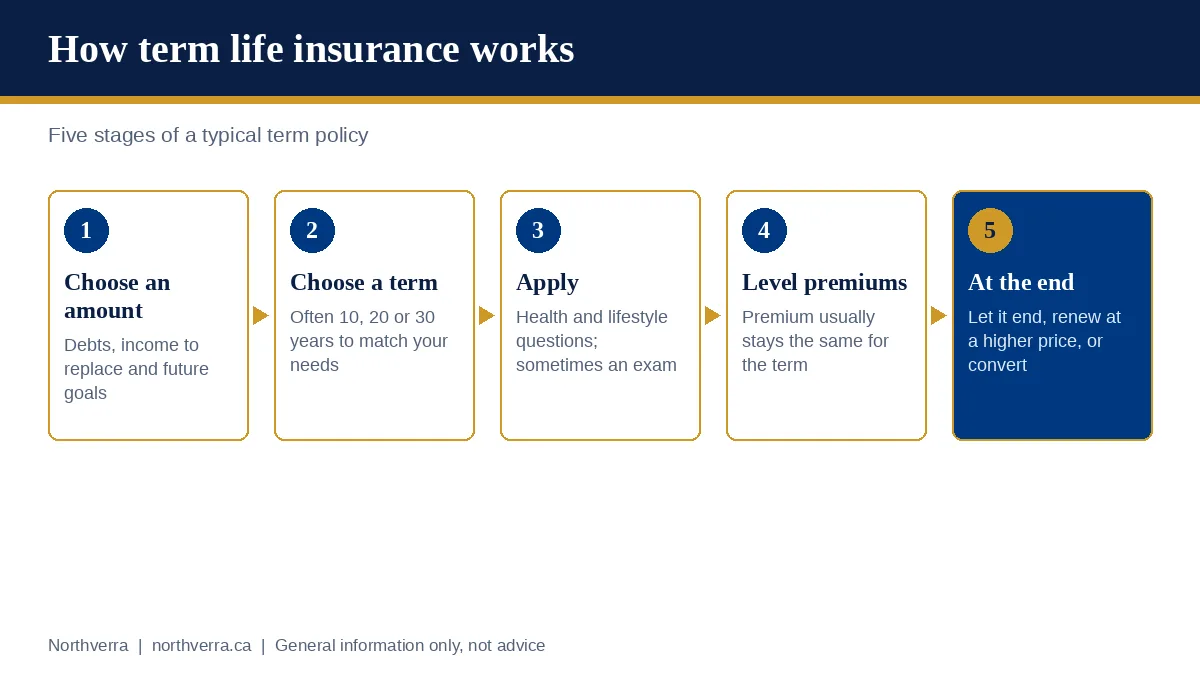
- Choose an amount. Estimate how much money your family would need to cover debts, replace income and fund future goals. Our guide on how much life insurance you need walks through the calculation.
- Choose a length. Pick a term that lasts as long as the need, such as the remaining years on a mortgage.
- Apply. You answer questions about your health, lifestyle and finances. Depending on the amount and your age, the insurer may ask for a medical exam, blood work or records from your doctor.
- Pay level premiums. Once approved, your premium usually stays the same for the whole term.
- Decide at the end. When the term expires, you can let it end, renew it or convert it, depending on the contract.
Common term lengths and what they are often used for
| Term length | Premium compared with shorter terms | Often used for |
|---|---|---|
| 10 years | Lower starting premium than longer terms | Short-term debts, a business loan, a gap until other savings grow |
| 20 years | Moderate | Raising young children, the bulk of a mortgage |
| 30 years | Higher | Young families with a new mortgage and a long horizon |
| To age 65 or later | Higher still | Covering the working years until retirement |
Longer terms cost more at the start because the insurer is committing to a fixed price for longer, but they can cost less over time than buying a shorter term and renewing it at an older age.
Renewal and conversion: the features people overlook
Two contract features make a big difference later in life.
Renewal
A renewable term policy lets you extend coverage for another term without proving your health again. The catch is price: the renewal premium is based on your age at renewal, and it can be several times higher than your original premium. Renewal is most useful if your health changes and you still need coverage.
Conversion
A convertible term policy lets you switch some or all of your coverage to a permanent policy without new medical evidence, usually before a deadline age stated in the contract. Conversion can be valuable if you develop a health condition and later decide you want lifelong coverage, for example for estate planning.
What affects the cost of term life insurance?
Insurers price term coverage on the chance that they will have to pay a claim during the term. The main factors are:
- Age: premiums rise with each year of age, so applying earlier usually costs less.
- Health and family history: conditions, medications, height and weight and family history can all matter.
- Tobacco and cannabis use: smokers generally pay much more than non-smokers.
- Coverage amount and term length: more coverage and longer terms cost more.
- Lifestyle and occupation: some activities and jobs carry higher risk.
- Riders: optional extras add to the premium.
For an Alberta-specific look at pricing factors, see how much life insurance costs in Alberta.
Riders you may be offered
Riders are optional add-ons. They can be useful, but each one adds cost, so it is worth asking whether you would really use it.
- Waiver of premium: premiums are waived if you become totally disabled, as defined in the policy.
- Child term rider: a small amount of coverage for your children.
- Accidental death benefit: an extra payout if death is caused by an accident.
- Critical illness rider: a lump sum if you are diagnosed with a covered illness, subject to the policy terms.
- Return of premium: some or all premiums are returned if you outlive the term, at a much higher cost.
Term life insurance through work versus a personal policy
Many employers offer group life insurance, often one or two times your salary. It is convenient and may not require medical questions. The limits are that the amount may not be enough for a family with a mortgage, and coverage usually ends or changes when you leave the job or retire. A personal term policy stays with you regardless of where you work. Our guide on employer versus private life insurance compares the two.
Example (hypothetical): Maya, 34, has a 25-year mortgage and two children under 5. She has group coverage of two times her salary at work. She decides to add a personal 25-year term policy so her family would have enough to pay off the mortgage and replace part of her income, even if she changes employers.
Is term life insurance right for you?
Term coverage tends to fit well when your need for protection has an end date. As your mortgage shrinks, your savings grow and your children become independent, the amount of insurance you need usually falls. Permanent insurance may make more sense when the need lasts for life, such as covering taxes on an estate or leaving a set amount to heirs. Many households use term insurance for their main protection and add a smaller permanent policy for lifelong needs.
Key takeaways
- Term life insurance is designed to protect people who depend on your income for a specific stretch of years.
- Match the length of the term to your longest major obligation, such as a mortgage or the years until your children are independent.
- Check the renewal and conversion rules before you buy; they matter more as you get older.
- Your age, health, smoking status, coverage amount and term length drive the premium.
- Group coverage at work is useful, but it usually ends when you leave the job.
Who this guide is for
- Parents with young children or a single household income.
- Homeowners who want their mortgage covered if something happens.
- Couples who rely on both incomes to cover their monthly costs.
- Anyone whose need for protection has a clear end date.
Questions to ask an insurance advisor
- How much coverage do I need, and for how many years?
- Is this policy renewable and convertible, and until what age?
- What happens to my premium at renewal?
- Which riders would actually help my situation, and what do they cost?
- How does this policy work alongside my group coverage at work?
Frequently asked questions
How long should a term life insurance policy be?
A common approach is to match the term to your longest major obligation. If your mortgage has 22 years left and your youngest child is 4, a 20 or 25 year term may cover the years your family would feel the loss of your income most. Some people combine two shorter and longer policies to match obligations that end at different times.
What happens when my term life insurance ends?
Depending on the contract, you can usually let it end, renew it for another term at a higher premium based on your age at renewal, or convert it to a permanent policy without new medical questions before a deadline age. If you do nothing and the policy is not renewable, coverage simply stops and no money is paid out.
Can I cancel term life insurance early?
Yes. You can usually stop paying premiums and the policy will lapse. Because most term policies have no cash value, you will not get money back, so it is worth putting replacement coverage in place first if you still need protection.
Is term life insurance worth it if I never make a claim?
Term insurance is protection, not savings. You are paying for the certainty that your family would receive a lump sum during the years they depend on you. Many people view that like home or car insurance: it is valuable because of what it covers, even if it is never used.
Can I get term life insurance with a health condition?
Often, yes. Insurers look at the condition, how well it is managed and your overall health. You may be offered standard pricing, a higher premium, or a policy with simpler underwriting. Our guide on life insurance with health problems explains the options.
Is the payout from term life insurance taxable in Canada?
A death benefit paid directly to a named beneficiary is generally received tax-free, according to the FCAC. If the estate is named as beneficiary, the money becomes part of the estate and may be exposed to probate fees and creditors.
What is the difference between term life and mortgage insurance from my lender?
Lender mortgage insurance usually pays the lender, and the benefit can shrink as your balance falls. A personal term policy pays your chosen beneficiary, keeps the same death benefit and stays with you if you switch lenders. See life insurance and your mortgage.
Can I have more than one term life insurance policy?
Yes. Some people hold two or more policies with different lengths, often called laddering. For example, a larger 20-year policy for the mortgage years and a smaller 30-year policy for longer-term needs. The total coverage still has to make sense for your income and needs.
Last updated: October 11, 2026
Related guides
- Term vs. whole life insurance: Which is better?
- How much life insurance do I need?
- How much does life insurance cost in Alberta?
- Should I get life insurance through my employer or privately?
- Whole Life vs. Universal Life Insurance
- All life insurance questions, answered
Talk it through with us
Every situation is different. If you would like to talk about how this applies to you, we are happy to walk through your questions with no obligation.
Have a question? Start a conversation
Tell us a little about your situation. We will reply within one business day.
By submitting this form you agree that Northverra may contact you about your enquiry. Please do not include account numbers, health details or other sensitive information. See our Privacy Policy.
Important information. Life insurance products are subject to underwriting, eligibility, exclusions, limitations and the terms of the policy contract. Coverage, premiums and availability depend on your age, health, lifestyle and other factors. Nothing on this page is an offer of insurance or a guarantee of coverage or price. See our Disclosures.
Important information. The information on this page is general in nature, is provided for educational purposes only, and is not personalized financial, insurance, legal, tax or mortgage advice. Your circumstances are unique. Please speak with a properly licensed professional before making decisions. See our Disclosures.