
LIFE INSURANCE TOOL
Life Insurance Premium Estimator: Term vs Whole vs Universal
Short answer: This life insurance premium estimator shows illustrative monthly ranges for term life and for whole or universal life, side by side. Move the sliders for age and coverage, choose smoking status, and the ranges update. Term life usually costs far less at the start because it covers a set number of years; whole and universal life cost more because they are designed to last for life and can build cash value. Every range comes from public Canadian sample figures, not live quotes.
Quick facts
- Built from public sample tables published by nine Canadian insurers and comparison sites, collected October 11, 2026
- In those samples, a 35-year-old non-smoking woman with $500,000 of coverage sees roughly $19 to $39 a month for a 20-year term and roughly $235 to $345 a month for pay-for-life whole life
- Smoking often doubles or triples the sample premiums
- Where no public sample exists (for example universal life for smokers), the panel shows Request a quote instead of a guess
- Your actual premium is set by an insurer after an application and underwriting
On this page: Try the life insurance premium estimator · How to read your estimate · Term vs whole vs universal life at a glance · What moves your premium up or down · Why permanent coverage costs more, and what it can do · Sources and assumptions · FAQ

Try the life insurance premium estimator
Set your age, the coverage amount, your smoking status and sex at birth (insurers price by it). The left panel shows term life for 10, 20 or 30 years. The right panel switches between whole life and universal life. Below each panel you will find the main benefits of that type of coverage and the trade-offs to weigh. Not sure how much coverage to test? Start with how much life insurance you may need.
IllustrativeRanges built from public Canadian sample figures. These are not live quotes and not offers of insurance.
The estimator could not load. Please use the contact form below and we will walk you through example costs.
Term life
Coverage for a set number of years
Estimated monthly premium range
Loading
Illustrative example only. Not a quote. Actual premiums depend on age, health, smoking status, coverage amount, term and insurer.
Assumes an applicant in good health and premiums that stay level for the term.
Opens the contact form on this page. An actual premium is set by an insurer after an application and underwriting.
Term life: benefits
- Lower starting cost than permanent coverage for the same amount of protection
- Simple to understand: choose an amount and a number of years
- Covers a set period, such as the years left on a mortgage or while children are growing up
- Can often be renewed, and may be convertible to permanent coverage; check the policy for conversion deadlines and terms
- A good fit for temporary needs, such as debts or replacing income during your working years
Term life: things to weigh
- No cash value: if the term ends and you are still living, the policy pays nothing
- Coverage ends at the end of the term unless you renew or convert it, usually at a higher premium based on your age at that time
- Renewal premiums can climb steeply at older ages
- Conversion rights usually have a deadline or maximum age that varies by policy
Whole life and universal life
Permanent coverage that can build cash value
Estimated monthly premium range
Loading
Illustrative example only. Not a quote. Actual premiums depend on age, health, smoking status, coverage amount, term and insurer.
Opens the contact form on this page. An actual premium is set by an insurer after an application and underwriting.
Whole and universal life: benefits
- Coverage for life, as long as the premiums (or, for universal life, the required funding) are kept up
- Can build cash value over time. Whole life: a guaranteed portion set out in the contract. Universal life: growth depends on the investment options you choose and is not guaranteed
- You may be able to borrow against the cash value with a policy loan, or use the policy as collateral for a loan, to help unlock opportunities such as a business need or a major purchase
- Can support estate planning, such as leaving an inheritance, covering taxes at death or making a charitable gift
- Can support business planning, such as funding a buy-sell agreement or protecting against the loss of a key person
- Some universal life policies offer flexible premiums within set limits
Whole and universal life: things to weigh
- Premiums are much higher than term for the same coverage, often several times higher
- Universal life cash value growth is not guaranteed and can fall with investment performance; an underfunded policy can lapse
- Fees and insurance charges reduce the cash value, and cash value usually builds slowly in the early years
- Policy loans accrue interest; unpaid loans and interest reduce the death benefit and can cause the policy to lapse
- Surrender charges may apply if you cancel in the early years
- Withdrawals, policy loans or a surrender can be taxable in some cases
The right choice depends on your goals, budget and health: an advisor can help compare.
See every sample figure the estimator uses
How to read your estimate
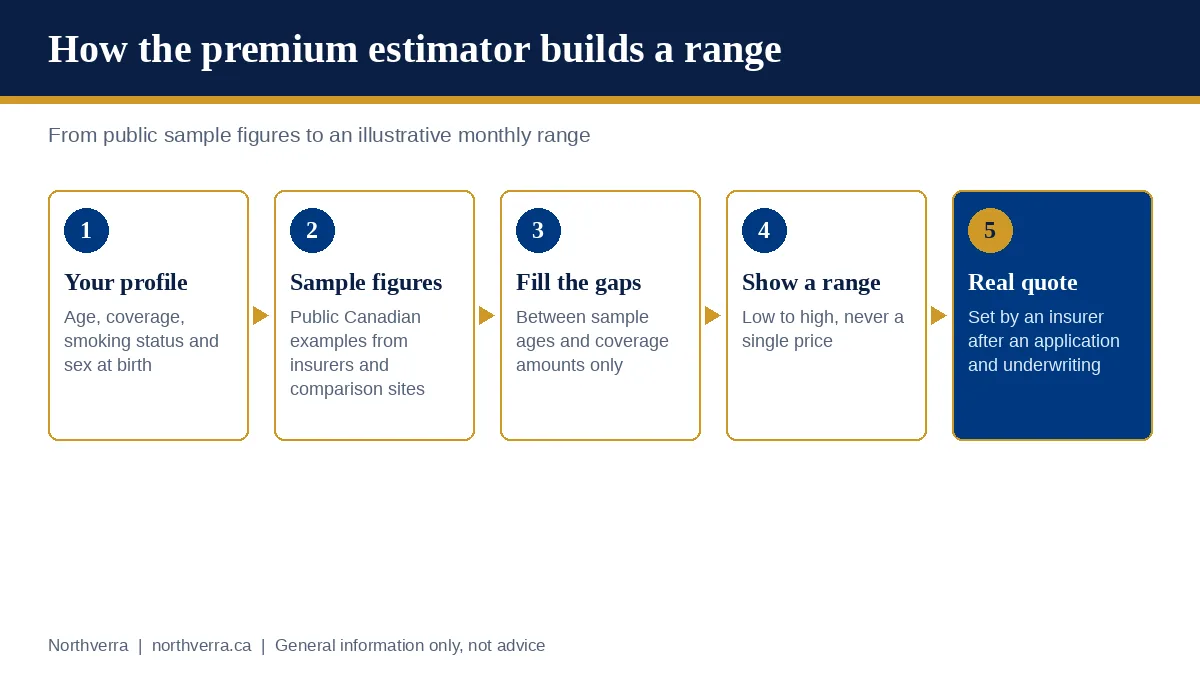
Each panel shows a monthly range, not a price. The estimator looks for published sample premiums that match your settings: the same type of policy, term length, sex at birth and smoking status. If a sample exists for your exact age and coverage, it is used directly. If your age falls between two sample ages, or your coverage falls between two sample amounts, the estimator fills the gap only between those published points. It never stretches a sample beyond the ages or amounts the source actually published.
When two or more sample figures fit, the range runs from 15% below the smallest figure to 15% above the largest. When only one fits, the range is 20% either side of it. The line under each number tells you how many sample figures were used and whose they were. A range built from four sources is a firmer guide than a range built from one.
A grey panel that says Request a quote means we did not find a public sample for that combination. That happens most often for smokers buying universal life, for 30-year terms after age 50, and for larger term policies after age 60. When sample data exists at a different coverage amount for your age, a button offers to jump to it.
Term vs whole vs universal life at a glance
| Feature | Term life | Whole life | Universal life |
|---|---|---|---|
| How long it lasts | A set period, such as 10, 20 or 30 years | For life, while premiums are paid | For life, while the policy is funded |
| Starting premium | Lower | Higher | Higher, varies with the plan |
| Cash value | None | Yes, with a guaranteed portion | Yes, growth depends on investment options and is not guaranteed |
| Borrowing | Not available | Policy loans against cash value | Loans or withdrawals from the account value |
| Flexibility | Renew or convert, depending on the policy | Fixed premiums; some plans pay up in 10 or 20 years | Premiums and coverage can change within limits |
| Common uses | Mortgage years, raising children, income replacement | Estate planning, lifelong needs | Estate and business planning with more control |
For a deeper comparison of the two permanent options, see our guide to whole life vs. universal life insurance. If you are leaning toward temporary coverage, our term life insurance guide walks through term lengths, renewals and conversion.
What moves your premium up or down
- Age. Premiums rise with every birthday, slowly in your twenties and thirties and faster after about 45.
- Health and family history. Conditions such as high blood pressure, diabetes or heart disease can raise the premium or limit the options.
- Smoking and nicotine. Any tobacco or nicotine use, including vaping, is usually priced as smoking. Several insurers note that 12 months without nicotine can open the door to non-smoker rates.
- Coverage amount. More coverage costs more, though the cost per $1,000 often drops at larger amounts.
- Term length or payment period. A 30-year term costs more each month than a 10-year term. Whole life paid up in 20 years costs more each month than whole life paid for life.
- How you apply. Simplified or no-medical products ask fewer questions and are often priced higher than fully underwritten coverage.
- The insurer. Each company sets its own rates, which is why the sample figures for the same person differ.
If you live in Alberta, our page on life insurance costs, coverage and options in Alberta covers the local side of these factors.
Why permanent coverage costs more, and what it can do
A term policy pays only if you die during the term, and most terms end without a claim. That is why term can be so affordable while your needs are temporary. Whole life and universal life are built to pay a benefit whenever you die, as long as the policy stays in force, and part of every premium goes into a cash value reserve inside the policy.
That cash value is the reason many people choose permanent coverage. It can build over time: whole life includes a guaranteed portion written into the contract, and participating whole life may also receive dividends, which are not guaranteed. Universal life cash value depends on the investment options you choose inside the policy, so it can grow or shrink. Once value has built up, you may be able to borrow against it through a policy loan, or use the policy as collateral for a bank loan, to help unlock opportunities such as funding a business need or a major purchase while the coverage stays in place.
Borrowing has costs. Policy loans charge interest, and any unpaid loan and interest is subtracted from what your beneficiaries receive. Fees and insurance charges reduce the cash value, especially in the first years, and surrender charges may apply if you cancel early. Withdrawals, loans or a surrender can also trigger tax in some cases. Permanent coverage is often used in estate planning and by business owners, where a lifelong need justifies the higher premium.
Sources and assumptions
All figures in the estimator are monthly premiums published on the public pages below, for the example applicants each source describes. We copied the numbers as published and did not adjust them for inflation or later rate changes. Listing a source does not mean that company endorses this page or Northverra.
- TD Insurance, How much does life insurance cost? (TD Term Life examples). Premiums calculated as of September 2026 (page updated October 10, 2026); accessed 2026-10-11. Used: TD Term Life, person in good health, no discounts; 10, 20 and 30-year terms; ages 20 to 50; female and male; non-smoker and smoker; $100,000, $250,000, $500,000 and $1 million.
- Sun Life, Term life insurance rates in Canada (Sun Life Go Term Life Insurance). Rates as of October 2026; accessed 2026-10-11. Used: 10-year rates; ages 20 to 60; female and male; non-smoker and smoker; $100,000, $500,000 and $1 million. Product may skip medical tests for some applicants, which the page says can mean higher rates.
- Sun Life, Term life insurance rates in Canada (Sun Life Evolve Term Insurance). Rates as of May 26, 2025; accessed 2026-10-11. Used: 10-year rates; ages 20 to 60; male non-smoker, male smoker and female non-smoker; $100,000 and $1 million (female smoker table not used: its figures looked inconsistent).
- PolicyAdvisor, How much does life insurance cost in Canada?. Page modified September 28, 2026; accessed 2026-10-11. Used: Illustrative 10-year term, non-smoker, ages 20 to 60 at $100,000 to $1 million; seniors table $100,000 to age 70 (term length not stated; matches the 10-year $100,000 table at 50 and 60); male smoker $500,000 10-year; male non-smoker $500,000 20 and 30-year (ages 30 to 45).
- RBC Insurance, How much does term life insurance cost in Canada?. Premiums as of February 2026 (page modified July 17, 2026); accessed 2026-10-11. Used: RBC Simplified Term Life, 20-year term, $500,000, ages 20 to 60, non-smoker and smoker, female and male; age-40 non-smoker table from $100,000 to $1 million.
- PolicyMe, How much does life insurance cost in Canada?. Table dated July 2026 and September 2026 (page updated September 1, 2026); accessed 2026-10-11. Used: Fully underwritten 20-year term, $500,000, ages 25, 35, 45 and 55, female and male, non-smoker and smoker; 35-year-old non-smoking woman by coverage ($100,000 to $1 million) for 10, 20 and 30-year terms.
- Ratehub.ca, Life insurance for smokers. Page modified January 6, 2026; accessed 2026-10-11. Used: 20-year term, $300,000, male, ages 30 to 60, smoker and non-smoker.
- Sun Life, Whole life insurance rates in Canada (SunSpectrum Permanent Life II). Rates as of November 16, 2025 (page updated December 4, 2025); accessed 2026-10-11. Used: Non-participating whole life; ages 20 to 75 (used to 70); female and male; non-smoker and smoker; $100,000, $500,000 and $1 million. Payment period not stated; figures match MyChoice pay-for-life examples, so treated as pay for life.
- PolicyAdvisor, How much does whole life insurance cost in Canada?. Page modified October 1, 2026; accessed 2026-10-11. Used: Illustrative non-participating whole life, pay for life, male non-smoker, $100,000, ages 20 to 60. (The page also shows 20-pay figures, which are not used in the estimator.).
- MyChoice, Whole life insurance in Canada. Page modified July 23, 2026; accessed 2026-10-11. Used: Ontario non-smoker, guaranteed whole life, pay for life; $500,000 at ages 25 to 65; age 35 at $250,000 to $1 million. (20-pay figures on the page are not used.).
- MyChoice, Universal life insurance in Canada. Page modified November 12, 2025; accessed 2026-10-11. Used: Ontario non-smoker, standard universal life; $500,000 at ages 25 to 65; age 35 at $250,000 to $1 million.
- HelloSafe, Universal life insurance in Canada. Page modified February 27, 2025; accessed 2026-10-11. Used: $250,000, $500,000 and $1 million at ages 30, 40 and 50, female and male. Smoking status and quote date are not stated on the page; treated as non-smoker sample figures.
- LowestRates.ca, Universal life insurance quotes. Example on page (date not stated); accessed 2026-10-11. Used: Age 30, Ontario, non-smoker, $400,000: male and female examples.
How the ranges are calculated
- Only sample figures that match your settings are used: product type, term length (for term), sex at birth and smoking status.
- Between two sample ages, premiums are filled in on a curve (each year rises by a similar percentage). Between two sample coverage amounts, they are filled in on a straight line.
- No figure is extended beyond the youngest or oldest age, or the smallest or largest coverage, that a source published. One exception is stated: for term life, ages 18 and 19 use the age-20 figures, because the published tables show little or no difference below age 20.
- Range: one matching figure gives 20% below to 20% above it; two or more give 15% below the smallest to 15% above the largest.
- Whole life figures are pay-for-life plans. Participating plans and plans paid up in 10 or 20 years cost more each month and are not part of the estimate.
- Data you can check: every sample figure is stored in the page as a data table, and you can open it under See every sample figure the estimator uses.
Combinations shown as Request a quote
- Universal life for smokers (no public smoker samples found).
- Whole life and universal life for ages 18 and 19 (samples start at age 20).
- 30-year term after age 50.
- 20-year term after age 50, except at $500,000 (and $300,000 for men), and after age 60 entirely.
- 10-year term after age 60, except non-smokers at $100,000 up to age 70.
- Universal life outside ages 30 to 50 at $250,000 to $1 million, except $500,000 from age 25 to 65; universal life under $250,000.
- Some smoker term combinations after age 50 that no source published.
Last updated: 2026-10-11. Sample figures change as insurers update their rates; we review the sources periodically.
Key takeaways
- Term life usually costs far less at the start for the same coverage, for a set number of years.
- Whole and universal life last for life and can build cash value, which may support borrowing, estate planning and business planning.
- Universal life cash value growth depends on the investment options chosen and is not guaranteed.
- Age and smoking status are among the biggest drivers of every sample premium.
- Treat every number here as an illustration; your real premium comes from an insurer after underwriting.
Who this tool is for
- People comparing term and permanent coverage before speaking with an advisor
- Families sizing coverage for a mortgage or children
- Business owners and anyone starting an estate plan
- Anyone curious how age or smoking changes the cost
Questions to ask an insurance advisor
- How much coverage do I need, and for how long?
- Can this term policy be converted, and until what age?
- What part of the whole life cash value is guaranteed?
- For universal life, what happens if returns are low?
- What would a policy loan cost, and how would it change the death benefit?
Frequently asked questions
Is this life insurance premium estimator a quote?
No. It shows illustrative ranges built from public sample figures that insurers and comparison sites published for specific example applicants. A quote comes from an insurer after it reviews your application and health questions, sometimes with a medical exam, and the final premium is only set once underwriting is complete.
Why does the estimator show a range instead of one price?
Different insurers price the same person differently, and the public examples were collected on different dates and for slightly different products. When two or more sample figures fit your settings, the range runs from 15% below the smallest to 15% above the largest; with one figure it is 20% either side. A range is a more honest picture than a single number.
Why do some settings show Request a quote?
We only estimate where a public sample figure exists at, or on both sides of, your age and coverage amount. We did not find public smoker figures for universal life, 30-year term samples past age 50, or most term samples beyond age 60 except at $100,000. Rather than guess, the panel turns grey and, where it can, points you to a coverage amount that has sample data.
How much more do smokers pay for life insurance?
In the public samples, often two to three times as much. TD’s September 2026 example for a 40-year-old man buying a 20-year, $500,000 term shows $51.15 a month as a non-smoker and $144.00 as a smoker. Insurers usually treat any tobacco or nicotine use as smoking, and several note you may qualify for non-smoker rates after 12 months without it.
Can I borrow against a whole or universal life policy?
Often yes, once the policy has built cash value. A policy loan uses the cash value as security, and some lenders accept a policy as collateral for a separate loan. Loans charge interest, and any unpaid loan and interest is subtracted from the death benefit. A loan can also have tax consequences if the policy lapses or is surrendered, so review the terms first.
Can I start with term life and switch to permanent coverage later?
Many term policies include a conversion option that lets you change to permanent coverage without new medical evidence, but only before a deadline or maximum age set in the contract. The new premium is based on your age when you convert, so it will be higher than if you had bought permanent coverage earlier. Check the conversion terms before you buy.
Why is whole life so much more expensive than term?
A term policy only pays if you die during the term, and most terms end without a claim. Whole life is designed to pay a benefit whenever you die, as long as it stays in force, and part of each premium builds a cash value reserve. That lifetime promise and the savings component are why the monthly cost starts several times higher for the same coverage.
Do whole life premiums go up as I get older?
Usually not after you buy. Most whole life premiums are set when the policy is issued and stay level, which is why the estimator uses your age at purchase. Some plans let you finish paying in 10 or 20 years, which raises the monthly amount during those years. Universal life can differ: some plans have insurance costs that rise with age, so ask how they are set.
Last updated: October 11, 2026
Related guides
- Life insurance: how it works and your options
- How much life insurance do I need?
- Term life insurance in Canada
- Whole life vs. universal life insurance
- Life insurance in Alberta: costs, coverage and options
- All life insurance questions, answered
Talk it through with us
Every situation is different. If you would like to talk about how these ranges apply to you, we are happy to walk through your questions with no obligation.
Ask about a real quote
Tell us a little about your situation and what you are comparing. We will reply within one business day.
By submitting this form you agree that Northverra may contact you about your enquiry. Please do not include account numbers, health details or other sensitive information. See our Privacy Policy.
Important information. Life insurance products are subject to underwriting, eligibility, exclusions, limitations and the terms of the policy contract. Coverage, premiums and availability depend on your age, health, lifestyle and other factors. Nothing on this page is an offer of insurance or a guarantee of coverage or price. See our Disclosures.
Important information. The information on this page is general in nature, is provided for educational purposes only, and is not personalized financial, insurance, legal, tax or mortgage advice. Your circumstances are unique. Please speak with a properly licensed professional before making decisions. See our Disclosures.