
Term vs. Permanent Life Insurance: How to Tell the Difference
Short answer: Term life insurance covers you for a set number of years and is usually the most affordable. Permanent life insurance, including whole and universal life, is designed to last your lifetime and may include a cash value. The right choice depends on your goals, budget and time horizon.
In this guide: Term insurance · Permanent insurance · Types of permanent · Key differences · Questions to ask · A closer look at how long coverage lasts · Examples of when each kind often fits · How the money works inside permanent insurance · The role of riders · A decision framework · How to review your choice over time · FAQ
What is term life insurance?
Term insurance covers you for a fixed period, commonly 10, 20 or 30 years. If you pass away during the term, the policy pays the death benefit. If the term ends and you are still living, coverage ends unless it is renewed or converted.
- You need a large amount of protection for a specific period
- You are raising children or paying down a mortgage
- You want to keep premiums lower in your highest-responsibility years
What is permanent life insurance?
Permanent insurance is designed to remain in force for your lifetime as long as the policy requirements are met. Some permanent policies build a cash value inside the policy.
- You want lifelong coverage for estate planning or legacy goals
- You have dependants who will need support for life
- You understand the costs, the cash value feature and the long-term commitment
Types of permanent insurance
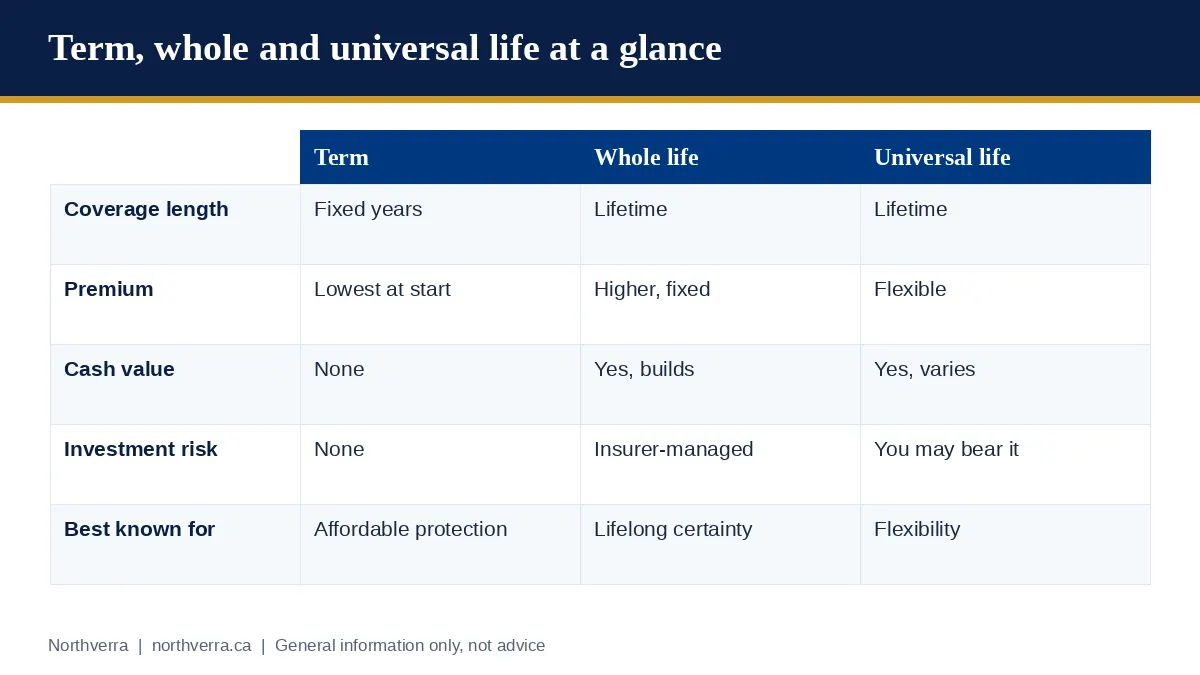
The two main kinds in Canada are whole life and universal life. Whole life offers a guaranteed death benefit and level premiums as set out in the policy, with a cash value that builds under the policy terms. Universal life is more flexible and often lets the policyholder direct part of the cash value into investment options, which brings investment risk. See our guides on universal life and whole life dividends.
Key differences
- Length: a fixed period versus a lifetime
- Cost: term premiums are usually lower at the start for the same amount
- Cash value: typically none with term, available in some permanent policies
- Flexibility: term can sometimes be converted to permanent, depending on the policy
Questions to ask before you decide
- How long will people depend on my income?
- What would my family need to cover if I were gone?
- Can I keep paying the premiums for the long term?
- Does the term policy allow renewal or conversion, and at what cost?
For a direct comparison of term and whole life, read which is better. To size your coverage, see how much you may need.
Next step
Not sure which fits? A short conversation can make the options clearer.
A closer look at how long coverage lasts
Term policies are sold in standard lengths such as 10, 20 or 30 years, and some insurers also sell ‘term to 100’ products that behave much like permanent insurance. Always read how long the coverage lasts and what happens at the end. Some term policies renew each year after the initial term at sharply higher premiums, and many people let them lapse at that point. Others convert to a permanent policy if you act in time.
Examples of when each kind often fits
Term examples
- A couple in their thirties with a new mortgage and young children
- A business owner who needs coverage for the length of a loan
- Someone who wants coverage in place before their savings have grown
Permanent examples
- A parent with a child who will always need support
- A family who wants a guaranteed estate for heirs
- An owner of a private company planning for tax on the shares at death
How the money works inside permanent insurance
In a permanent policy, premiums pay for the cost of insurance, the insurer’s expenses and, in many cases, a cash value. Over the first years, the cost of insurance and expenses can leave little cash value. Over time the cash value may grow. In whole life the growth is mostly set out in the contract, while in universal life it depends on the investments you select. Our guides on cash value and participating policies explain the details.
The role of riders
Riders are add-ons. Common ones include waiver of premium (if you become disabled), critical illness, child term and guaranteed insurability, which lets you add coverage later without new medical questions. Riders cost extra, so choose those that solve a real problem for you.
A decision framework
- Start with the need: how much, for whom and for how long?
- Decide whether the need ends or lasts a lifetime
- Set a budget you can keep up for decades
- Compare the guaranteed values and the cost over time
- Review the plan whenever your life changes
If it helps, use our guide on how much life insurance you may need to start with the amount.
How to review your choice over time
Your first decision does not have to be your last. Review your coverage whenever you buy a home, have a child, start a business, get divorced or approach retirement. A policy that was right at 30 may be too small, too large or the wrong type at 50. Keep the conversion deadline on any term policy in your calendar, because it is one of the most valuable features you can lose by forgetting about it.
Questions people ask
Which is cheaper, term or permanent?
Term is usually much cheaper per month for the same death benefit, because it covers a limited time and has no cash value.
Can I switch from term to permanent?
Often yes, if the policy has a conversion option. Check the age limit and the deadline.
Does permanent insurance always build wealth?
Not necessarily. Early years often build little value, and results depend on the policy and the insurer. Review the guaranteed values.
What happens if I stop paying a permanent policy?
It may lapse, or you may be able to use the cash value to keep it going for a time, or take a reduced paid-up amount. Rules vary, so ask the insurer before stopping.
Is permanent insurance only for the wealthy?
No, but the higher cost means it needs to match a clear purpose and fit within your budget.
Related guides
- Term vs. whole life: which is better?
- What is cash value life insurance?
- How much life insurance do I need?
- Life insurance overview
Have a question? Start a conversation
Tell us a little about your situation. We will reply within one business day.
By submitting this form you agree that Northverra may contact you about your enquiry. Please do not include account numbers, health details or other sensitive information. See our Privacy Policy.
Important information. Life insurance products are subject to underwriting, eligibility, exclusions, limitations and the terms of the policy contract. Coverage, premiums and availability depend on your age, health, lifestyle and other factors. Nothing on this page is an offer of insurance or a guarantee of coverage or price. See our Disclosures.