
MORTGAGE GUIDE
Mortgage Rates in Alberta
Short answer: Mortgage rates in Alberta are set by each lender. Variable rates follow the lender’s prime rate, which tracks the Bank of Canada’s policy rate; fixed rates follow bond yields. Your offer then depends on your down payment, credit, term, mortgage insurance and the property. Comparing offers on the same terms shows which rate is competitive. Rates are subject to change.
Mortgage Rates
Here are the posted rates one Canadian mortgage brokerage advertised for Alberta. They are third-party market rates, not Northverra’s rates.
| Term | Type | Rate | Date |
|---|---|---|---|
| 1-year | Fixed | 4.54%* | Oct 11, 2026 |
| 2-year | Fixed | 4.39% | Oct 11, 2026 |
| 3-year | Fixed | 4.49%* | Oct 11, 2026 |
| 4-year | Fixed | 4.44% | Oct 11, 2026 |
| 5-year | Fixed | 4.59%* | Oct 11, 2026 |
| 5-year | Variable | 3.49% | Oct 11, 2026 |
| 5-year open | Open† | 4.20% | Oct 11, 2026 |
| 6-month | Fixed | 2.49% | Oct 11, 2026 |
| 2-year (40-year amortization) | Fixed | 5.54% | Oct 11, 2026 |
* The source describes these rates as available for high-ratio (insured) purchases, with geographical restrictions, new business only and a minimum mortgage amount. It also notes that extra premiums may apply to rentals, extended amortizations, non-standard properties and alternative lending, and that equity and credit affect the final rate. Ranges shown by the source: 3-year fixed 4.49% to 4.99%; 5-year fixed 4.59% to 4.99%; 5-year variable up to 5.00%. † The source does not say whether its open rate is fixed or variable.
Bank of Canada: policy interest rate 2.25% (as of October 8, 2026); prime rate 4.45% as published by the Bank of Canada (as of October 7, 2026). Each lender sets its own prime rate. Source: Bank of Canada, Canadian interest rates.
Mortgage rates are subject to change without notice. Rates shown were posted by True North Mortgage on Oct 11, 2026 and are not an offer or a quote from Northverra. Your actual rate depends on your credit, down payment, property, lender and mortgage type. Contact us for options based on your situation. Source: True North Mortgage Alberta rates page.
Last updated: October 12, 2026
Quick facts
- Alberta borrowers can choose from national banks, credit unions, ATB Financial, monoline lenders and mortgage brokers.
- Variable rates usually move with the lender’s prime rate, which tends to follow changes to the Bank of Canada’s policy rate.
- Fixed rates tend to follow Government of Canada bond yields for similar terms.
- For mortgages from federally regulated lenders, you must qualify at the greater of your contract rate plus 2% or 5.25%, under OSFI rules.
- The rates above were posted by one public source; check the Bank of Canada website for its policy rate and lenders for current offers.
In this guide: Mortgage rates · How mortgage rates are set · What affects the rate you are offered · Who lends in Alberta · How to compare mortgage rate offers fairly · The stress test and your rate · Timing and rate holds · FAQ

If you are buying a home in Calgary, Edmonton or anywhere else in Alberta, your mortgage rate will be one of the biggest factors in your monthly payment and your total cost. This guide explains how mortgage rates are set, what affects the rate you are offered, and how to compare offers fairly. It includes a short table of rates posted by a Canadian mortgage brokerage; rates can change, so check lenders directly and the Bank of Canada’s website for its policy rate.
How mortgage rates are set
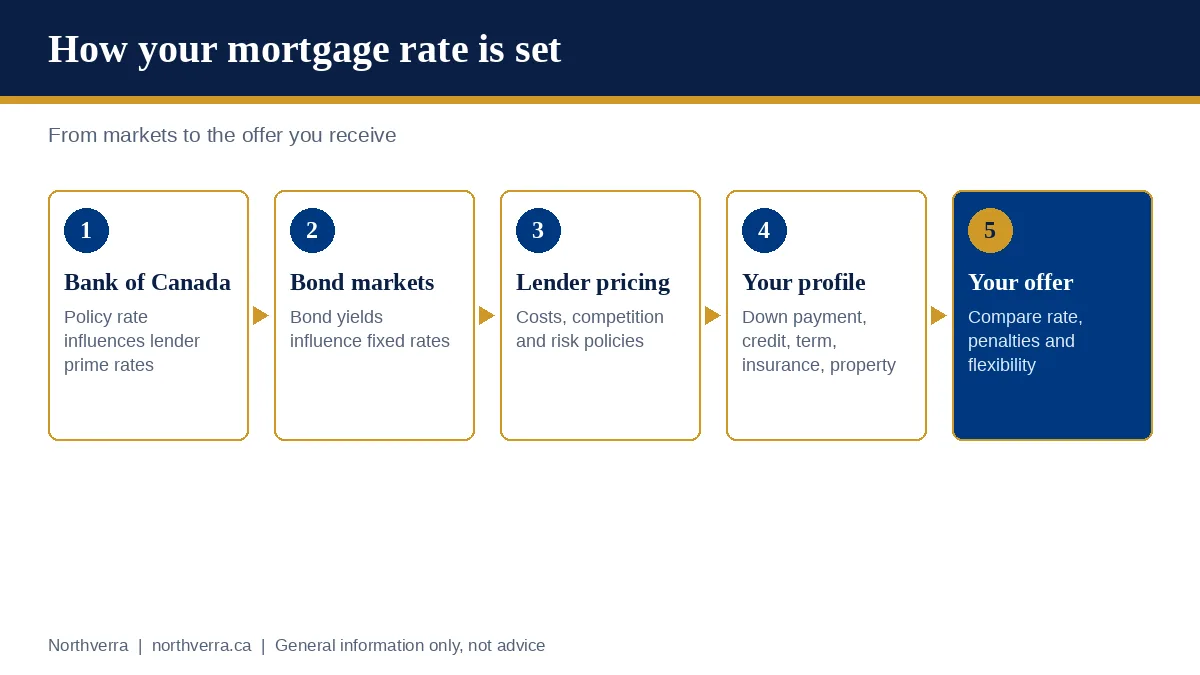
Mortgage rates start with broad market forces and end with your personal situation. Our guide to how mortgage interest rates work covers the mechanics in more depth.
Variable rates
Variable mortgage rates are usually expressed as the lender’s prime rate plus or minus a set amount. When the Bank of Canada raises or lowers its policy rate, lenders typically adjust prime, so variable rates and payments can change during your term.
Fixed rates
Fixed rates are influenced mainly by Government of Canada bond yields for similar terms, plus the lender’s costs and competition. When bond yields rise, fixed mortgage rates tend to rise, and when they fall, fixed rates often follow.
What affects the rate you are offered
| Factor | How it can affect your rate |
|---|---|
| Down payment and insurance | Insured mortgages, usually with less than 20% down, often get lower rates |
| Credit history | Stronger credit can widen your choice of lenders and improve pricing |
| Term and type | Different terms and fixed or variable options are priced differently |
| Amortization | Longer amortizations can affect pricing on some mortgages |
| Purpose | Refinances and rental properties are often priced higher than purchases |
| Property | Some property types, locations or conditions carry higher rates |
| Income documentation | Non-traditional income may lead to different lenders and rates |
| Lender type | Banks, credit unions, monoline lenders and private lenders price differently |
Who lends in Alberta
Alberta borrowers can choose from several kinds of lenders:
- Banks: federally regulated and follow OSFI rules, including the stress test.
- Credit unions and ATB Financial: provincially regulated, with their own lending policies, though many apply a similar qualifying test.
- Monoline lenders: mortgage-only lenders usually reached through brokers.
- Private lenders: for situations that do not fit traditional lending, usually at higher rates and fees.
How to compare mortgage rate offers fairly
- Compare offers for the same term, rate type and amortization.
- Check whether the rate is for an insured or uninsured mortgage.
- Look at prepayment privileges: how much extra you can pay each year without penalty.
- Understand how the penalty would be calculated if you break the mortgage early. See mortgage prepayment penalties.
- Ask about portability, rate holds and any fees.
- Use the mortgage calculator to see how each rate changes your payment.
Example (hypothetical): Two lenders offer a five-year fixed mortgage. Lender A’s rate is slightly lower, but it calculates penalties using a method that can be costly if you break the mortgage early, and it allows smaller prepayments. Lender B’s rate is a little higher, with more flexible prepayments. A buyer who expects to move within three years might prefer Lender B despite the higher rate.
The stress test and your rate
Even if you are offered a particular rate, federally regulated lenders must check that you could afford payments at a higher qualifying rate. Under OSFI rules, that is the greater of your contract rate plus 2% or 5.25%. See the mortgage stress test for how it affects how much you can borrow.
Timing and rate holds
Many lenders offer a rate hold when you get a pre-approval, which reserves a rate for a set period while you shop. If you are renewing, starting the process a few months before your renewal date gives you time to compare. See mortgage pre-approval.
Key takeaways
- Lenders set their own rates, so offers can differ for the same borrower.
- Your down payment, credit and whether the mortgage is insured can change your rate.
- Compare the full offer, including prepayment terms and penalties, not just the rate.
- A rate hold can protect you if rates rise while you shop for a home.
- A lower advertised rate does not always mean a lower overall cost.
Who this guide is for
- Albertans buying a home and comparing lenders.
- Homeowners approaching a mortgage renewal.
- Borrowers considering a refinance.
- Anyone trying to understand why their rate offer differs from advertised rates.
Questions to ask a mortgage professional
- Is this rate for an insured or uninsured mortgage?
- How long can you hold this rate for me?
- What are the prepayment privileges and how would a penalty be calculated?
- Is the mortgage portable if I move?
- What fees are included in this offer?
Frequently asked questions
Are mortgage rates in Alberta different from the rest of Canada?
Most lenders price mortgages nationally, so rates in Alberta are often similar to other provinces. Differences tend to come from the lender, the type of mortgage and your own profile rather than the province. Alberta-based lenders, such as credit unions and ATB Financial, add more options to compare.
Why is the rate I was offered higher than the advertised rate?
Advertised rates often apply to specific situations, such as insured mortgages, shorter closing periods or certain amortizations. Your down payment, credit, the property type and whether you are refinancing can all change the rate you are offered.
Do insured mortgages get lower rates?
Often, yes. Mortgage default insurance lowers the lender’s risk, so insured mortgages can come with lower rates even though you pay an insurance premium. See CMHC mortgage insurance.
How does the Bank of Canada affect my mortgage rate?
When the Bank of Canada changes its policy rate, lenders usually adjust their prime rates, which changes the rate on variable mortgages and HELOCs. Fixed rates are influenced more by bond markets, which react to expectations about the economy and inflation.
What is a mortgage rate hold?
A rate hold reserves a rate for a set period while you shop for a home or prepare to renew. If rates rise during that period, you keep the held rate; if they fall, many lenders let you get the lower rate. Terms vary by lender.
Does my credit score affect my mortgage rate?
It can. A stronger credit history can help you qualify with more lenders and may improve the rate you are offered. A weaker score may limit you to lenders with higher rates. See understanding your credit score.
Should I choose a fixed or variable rate?
It depends on your budget, how much payment change you can handle and your plans. Fixed rates offer certainty; variable rates move with prime. Our guide to fixed vs variable mortgages compares them.
Is it worth using a mortgage broker in Alberta?
A broker can compare offers from several lenders at once, which can save time and widen your choices. A bank or credit union can be a good fit if you value an existing relationship. See mortgage broker vs bank.
Last updated: October 12, 2026
Related guides
- How mortgage interest rates work in Canada
- Fixed vs variable mortgage: which is right for me?
- What is the mortgage stress test in Canada?
- Mortgage broker vs bank: which should I use?
- Mortgage calculator
- All mortgage questions, answered
Talk it through with us
Every situation is different. If you would like to talk about how this applies to you, we are happy to walk through your questions with no obligation.
Have a question? Start a conversation
Tell us a little about your situation. We will reply within one business day.
By submitting this form you agree that Northverra may contact you about your enquiry. Please do not include account numbers, health details or other sensitive information. See our Privacy Policy.
Important information. Mortgage approval, interest rates, terms and eligibility depend on the lender, your financial profile, the property and current market conditions, and are not guaranteed. Mortgage products and rates change. Nothing on this page is a commitment to lend or a quote of any rate. See our Disclosures.
Important information. The information on this page is general in nature, is provided for educational purposes only, and is not personalized financial, insurance, legal, tax or mortgage advice. Your circumstances are unique. Please speak with a properly licensed professional before making decisions. See our Disclosures.