
RRSP vs. TFSA: Understanding the Basics
Short answer: Use an RRSP when you want a tax deduction now and expect a lower tax rate when you withdraw, usually in retirement. Use a TFSA when you want tax-free growth with flexible, tax-free withdrawals for any goal. Many Canadians use both: the right mix depends on your income now and later, your goals and your available contribution room.
RRSPs and TFSAs are two of the most common registered accounts in Canada. They look similar, but they are treated differently for tax purposes. Here are the general differences. Limits and rules change, so confirm current details with the Canada Revenue Agency or a qualified professional.
How an RRSP generally works
- Contributions may be deducted from your taxable income, up to your contribution room
- Investments grow tax-deferred inside the account
- Withdrawals are generally added to your taxable income
How a TFSA generally works
- Contributions are made with after-tax money and are not deductible
- Growth inside the account is generally tax-free
- Withdrawals are generally tax-free, and the room can be used again in later years under the rules
Questions that help you choose
- Do I expect my income to be higher or lower in retirement than now?
- Do I want flexibility to withdraw funds before retirement?
- How much contribution room do I have in each?
- What other goals am I saving for?
Many people use both. The right mix depends on your income, goals and timeline.
A note on risk
Both RRSPs and TFSAs are account types, not investments in themselves. What you hold inside them can rise or fall in value.
Want to see how these accounts fit a wider plan? Visit our investment planning page, or read about life insurance for the protection side.
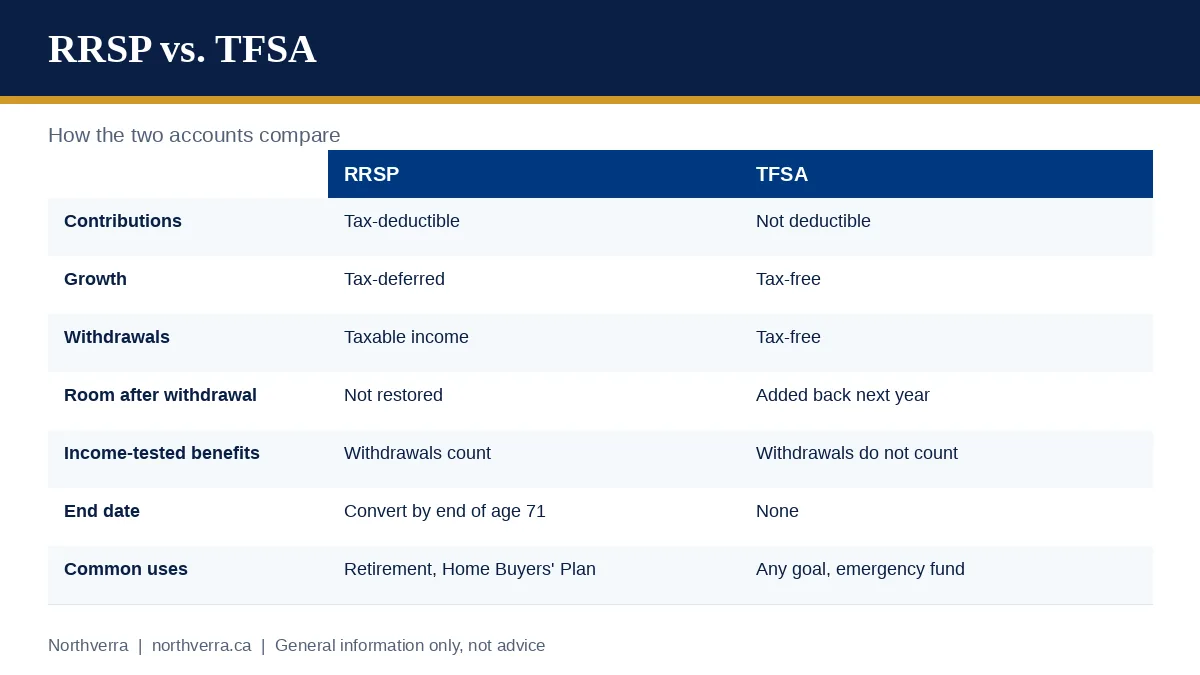
RRSP vs. TFSA at a glance
| Feature | RRSP | TFSA |
|---|---|---|
| Contributions | Tax-deductible, within your contribution room | Not deductible; made with after-tax money |
| Growth | Tax-deferred | Tax-free |
| Withdrawals | Added to taxable income, with tax withheld | Tax-free; the amount is added back to your room the next calendar year |
| Contribution room | Based on earned income, up to a yearly maximum; unused room carries forward | A yearly limit from age 18 for residents; unused room carries forward |
| Effect on income-tested benefits | Withdrawals count as income | Withdrawals do not count as income |
| Must close or convert | By the end of the year you turn 71 | No end date |
| Common uses | Retirement savings; the Home Buyers’ Plan | Emergency funds, short and long-term goals, retirement |
Check your exact contribution room in your CRA My Account or on your latest notice of assessment.
Which should you use? Common situations
- Higher income now, lower income in retirement: the RRSP deduction is often more valuable, because you save tax at a higher rate and pay it back at a lower rate later.
- Lower income now: a TFSA may come out ahead, because the RRSP deduction is worth less and withdrawals later could affect income-tested benefits.
- Saving for a goal in the next few years: a TFSA’s flexible, tax-free withdrawals often fit better.
- Buying a first home: both the RRSP Home Buyers’ Plan and the First Home Savings Account can help. See the Home Buyers’ Plan and the FHSA.
- Already used your RRSP room: a TFSA is a natural next step, followed by a non-registered account.
Using both together
Many households split their savings: the RRSP for retirement, with the tax refund reinvested in a TFSA, and the TFSA for flexibility and other goals. In retirement, drawing from both can help manage taxable income from year to year. Our guide to retirement planning in Alberta explains how withdrawal order affects taxes.
Example (hypothetical): Amira earns a high salary and expects a modest retirement income. She contributes to her RRSP, uses the tax refund to top up her TFSA, and keeps three months of expenses in a high-interest savings account inside her TFSA as an emergency fund.
Common RRSP and TFSA mistakes
- Over-contributing because room is not tracked across several accounts.
- Withdrawing from an RRSP for short-term needs and losing that contribution room permanently.
- Keeping a TFSA only in cash for years when the money is meant for long-term growth.
- Forgetting that a TFSA withdrawal is added back to your room only in the next calendar year.
- Choosing an account based on habit rather than your income now and in retirement.
Frequently asked questions
Can I have both an RRSP and a TFSA?
Yes. You can contribute to both as long as you stay within the contribution room for each account. Many Canadians use both for different goals.
What happens if I over-contribute to an RRSP or TFSA?
The CRA generally charges a tax of 1% per month on excess contributions until they are removed, with a small allowance for RRSPs. Track your room carefully, especially if you have accounts at more than one institution.
Is an RRSP or TFSA better on a low income?
On a lower income, a TFSA is often the better first choice, because the RRSP deduction saves less tax and RRSP withdrawals later count as income. You can also carry RRSP room forward and use it when your income rises.
Can I take money out of my RRSP without paying tax?
Generally, RRSP withdrawals are taxable and tax is withheld. Exceptions include the Home Buyers’ Plan and the Lifelong Learning Plan, which let you withdraw money for qualifying purposes and repay it over time.
Do TFSA withdrawals affect government benefits?
No. TFSA withdrawals are not taxable income, so they do not affect income-tested benefits such as the Guaranteed Income Supplement or the OAS recovery tax.
What can I hold inside an RRSP or TFSA?
Both can hold many qualified investments, such as cash, GICs, mutual funds, ETFs, stocks and bonds. The account is the tax wrapper; the investments inside it determine your risk and return.
When is the RRSP contribution deadline?
Contributions made in the first 60 days of a year can usually be deducted on the previous year’s tax return. TFSA contributions can be made at any time, within your room.
Last updated: October 11, 2026
Next step
Tell us about your goals and we can explain how registered accounts may fit.
Related reading: Investment planning · Understanding risk and time horizon · How the FHSA works · RRSP to RRIF conversion · Capital gains tax in Canada · The RRSP Home Buyers’ Plan
Have a question? Start a conversation
Tell us a little about what you are working toward. We will reply within one business day.
By submitting this form you agree that Northverra may contact you about your enquiry. Please do not include account numbers, health details or other sensitive information. See our Privacy Policy.
Important information. Investing involves risk, including the possible loss of the amount invested. The value of investments can go down as well as up, and past performance does not guarantee future results. Nothing on this page is a recommendation or a promise of any return. Diversification and asset allocation do not ensure a profit or protect against loss. See our Disclosures.