
Mortgage Renewal: What to Review Before You Sign
Short answer: You can often switch lenders at renewal without a prepayment penalty, because your term has ended. Switching makes sense when another lender offers a better overall deal after fees. Since November 2024, uninsured borrowers making a straight switch between federally regulated lenders do not have to requalify under the stress test, according to OSFI.
When your mortgage term ends, your lender will typically send a renewal offer. Signing quickly can be convenient, but the renewal is also a moment to review your options.
Start early
Many borrowers begin reviewing several months before the renewal date, which leaves time to compare options.
What to look at
- The rate and term being offered, and how they compare with other options
- Prepayment privileges and penalties
- Whether your amortization still suits you
- Whether your needs have changed, for example a move, a new income or a goal like consolidating debt
Switching lenders
Moving your mortgage to a new lender at renewal may be possible, though there can be fees and requirements. Compare the full picture, not only the rate.
Questions to ask
- What would I pay if I leave this mortgage early?
- Can I make extra payments, and how much?
- Is the mortgage portable if I move?
Questions about borrowing? See our mortgage financing page, or read the first-time home buyer checklist.
Should you switch lenders at renewal?
Renewal is the one point in your mortgage where you can usually move without paying a penalty. That makes it a natural time to compare. Switching can make sense if another lender offers a lower rate, better prepayment privileges, more flexible terms, or features such as portability that suit your plans. Staying can make sense if your current lender’s offer is competitive, your situation has changed in a way that makes qualifying harder, or the savings are small once fees are counted.
| Consider | Staying with your lender | Switching lenders |
|---|---|---|
| Paperwork | Usually simple: sign the renewal | New application, documents and legal work |
| Qualifying | Usually no new qualification | Uninsured straight switches between federally regulated lenders no longer need the stress test; other changes may |
| Costs | Usually none | Possible legal, appraisal and discharge fees; some lenders cover part of them |
| Rate and terms | Compare the offer against the market | Often a chance to negotiate a better overall package |
What changed for switching lenders
Since November 21, 2024, OSFI no longer expects federally regulated lenders to apply the minimum qualifying rate, the stress test, to uninsured straight switches. A straight switch means moving your mortgage to another federally regulated lender at renewal without increasing the amount or the amortization. Lenders still review your application and affordability. If you want to borrow more or extend your amortization, the new lender will usually treat it as a new mortgage and you will need to qualify. See the mortgage stress test.
A renewal timeline
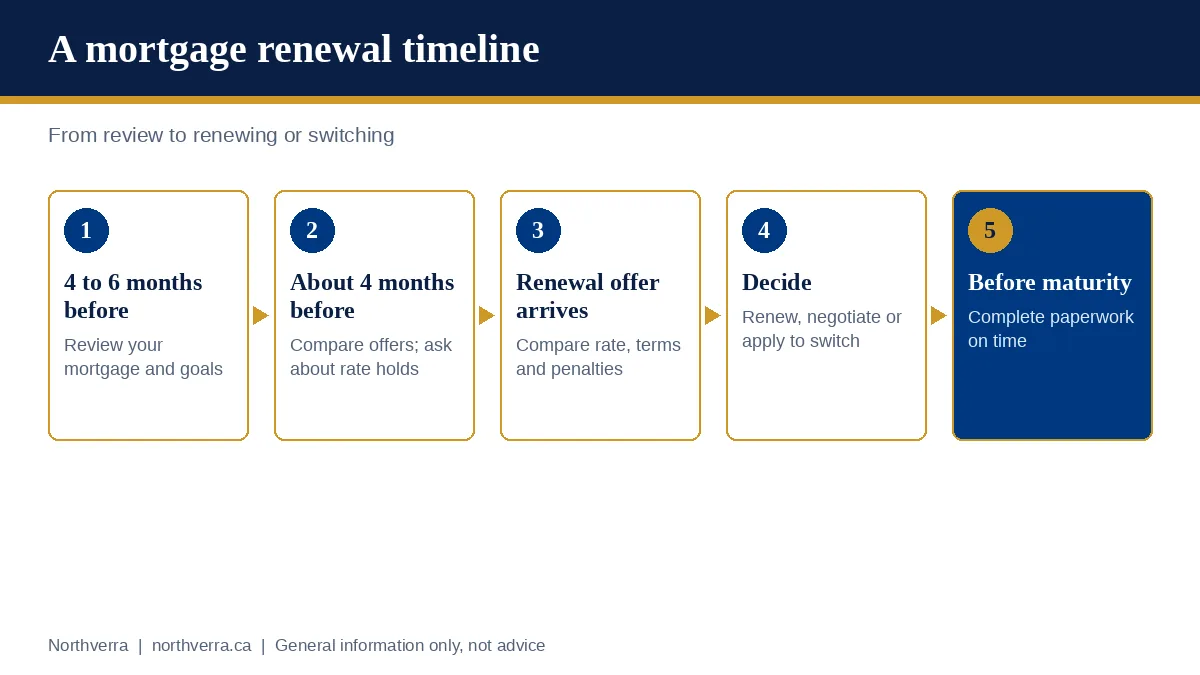
- Four to six months before: review your mortgage statement, goals and budget.
- About four months before: many lenders allow early renewal or rate holds; start comparing offers.
- When your renewal offer arrives: compare it with other lenders on rate, term, prepayment privileges and penalties.
- Decide: sign the renewal, negotiate with your lender, or apply to switch.
- Before your maturity date: if switching, complete the legal work so the new lender pays out the old mortgage on time.
Costs to compare before switching
- Legal or title fees for registering the new mortgage.
- An appraisal, if the new lender requires one.
- A discharge fee from your current lender.
- Any difference in prepayment privileges or penalty terms for the next term.
Compare the total savings over the term against these costs. Use the mortgage calculator to see how a different rate changes your payment, and read mortgage rates in Alberta for how to compare offers.
Example (hypothetical): Kim’s lender offers a renewal rate that is slightly higher than other offers she has seen. She asks her lender to match a competing offer. When it will not, she switches to another lender at renewal, keeping the same balance and amortization, and the new lender covers part of the legal costs.
Frequently asked questions
Can I switch lenders at renewal without a penalty?
Usually, yes. If you switch at the end of your term, there is generally no prepayment penalty. You may still pay a discharge fee and the new lender’s legal or appraisal costs.
Do I need to pass the stress test to switch lenders?
Under OSFI rules since November 21, 2024, uninsured straight switches between federally regulated lenders do not require the minimum qualifying rate test. If you increase the amount or the amortization, you will usually need to qualify.
How early can I renew my mortgage?
Many lenders let you renew or lock in a rate a few months before maturity without a penalty, often around four months. Renewing earlier than that may involve a penalty. Ask your lender about its policy.
What happens if I do nothing at renewal?
Some lenders automatically renew you for a set term at their offered rate, and others may move you to an open or short-term mortgage at a higher rate. Read your renewal letter carefully and respond before your maturity date.
Can I change my amortization or borrow more at renewal?
Yes, but it usually counts as a new mortgage or refinance, which means qualifying again and possibly paying more in fees. See when refinancing makes sense.
Should I just sign my lender’s renewal offer?
It may be competitive, but it is worth comparing. Lenders sometimes offer better rates to borrowers who ask or who show a competing offer.
Can I switch from fixed to variable at renewal?
Yes. Renewal is a good time to choose a new rate type and term. Our guide to fixed vs. variable mortgages explains the trade-offs.
Last updated: October 11, 2026
Next step
Planning a renewal? We can help you understand your choices.
Related reading: Mortgage financing · Buying your first home in Alberta · How mortgage amortization works · How to choose a mortgage term · Open vs closed mortgage · How prepayment penalties are calculated
Have a question? Start a conversation
Tell us a little about what you are working toward. We will reply within one business day.
By submitting this form you agree that Northverra may contact you about your enquiry. Please do not include account numbers, health details or other sensitive information. See our Privacy Policy.
Important information. Mortgage approval, interest rates, terms and eligibility depend on the lender, your financial profile, the property and current market conditions, and are not guaranteed. Mortgage products and rates change. Nothing on this page is a commitment to lend or a quote of any rate. See our Disclosures.