
INVESTMENT QUESTIONS
What are the main types of investments in Canada?
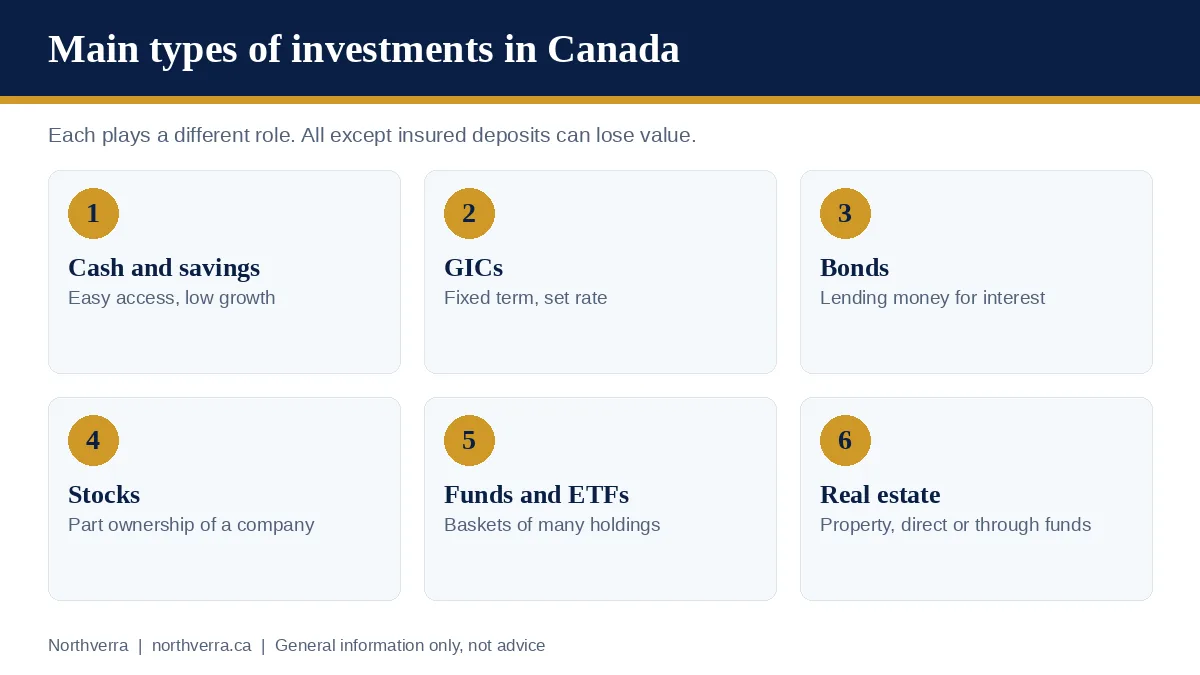
Short answer: The main types of investments in Canada are cash and savings, GICs, bonds, stocks, investment funds such as mutual funds and ETFs, and real estate. Each one has a different job: some aim to protect money, some aim to produce income and some aim to grow over the long term. Most plans use a mix.
In this guide: Lending investments: cash, GICs and bonds · Ownership investments: stocks and real estate · Investment funds: baskets of many investments · Accounts are not investments · How the types compare on risk, return and access · How to decide which types belong in your plan · Common mistakes to avoid · FAQ

When people first look at the types of investments in Canada, the list can feel long and full of jargon. It helps to remember that almost every investment falls into one of two basic ideas. You are either lending your money to someone in exchange for interest, or you are owning something, such as part of a company or a property, in the hope that it earns income or rises in value. Everything else is a variation or a combination of those two ideas.
Lending investments: cash, GICs and bonds
Cash and high-interest savings
Money in a savings account is the most flexible and the least likely to fall in value. The trade-off is that interest is usually modest, and over long periods it may not keep up with rising prices. Cash is best suited to an emergency fund and to money you will need within a short time. Our guide on building an emergency fund explains how much to keep there.
Guaranteed Investment Certificates (GICs)
A GIC is a deposit you agree to leave with a bank, credit union or trust company for a set term. In return you usually get a fixed rate of interest. Eligible GICs at member institutions may be covered by deposit insurance up to set limits. The main trade-off is access, since many GICs cannot be cashed before maturity. See how GICs work in Canada for the details.
Bonds
A bond is a loan to a government or a company. The issuer promises to pay interest and return the face value on a set date. Bond prices move when interest rates change, so you can lose money if you sell before maturity, and corporate bonds carry the risk that the issuer cannot pay. Compare them with shares in stocks vs bonds.
Ownership investments: stocks and real estate
Stocks (shares or equities)
Buying a share makes you a part-owner of a company. If the company does well, the share price may rise and the company may pay dividends. If it struggles, the price can fall sharply, and in the worst case a share can become worthless. Over long periods stocks have historically been a main source of growth for many investors, but past results do not predict future ones.
Real estate
Real estate includes your own home, rental properties and indirect ownership through real estate investment trusts (REITs) or funds. Property can provide rental income and may rise in value, but it needs a large amount of money to get started, it is slow to sell and it comes with costs such as maintenance, taxes and financing. We compare it with the stock market in real estate vs stocks.
Investment funds: baskets of many investments
Most Canadians do not buy individual bonds and shares one by one. They buy funds that hold many of them at once.
- Mutual funds pool money from many investors and are run by a professional manager. You buy and sell units at a price set once a day.
- Exchange-traded funds (ETFs) also hold a basket of investments, but they trade on a stock exchange during the day. Many follow an index.
- Segregated funds are offered by insurance companies and add certain guarantees on maturity and at death, usually for a higher fee.
- Balanced or asset allocation funds combine stocks and bonds in one fund for people who want a ready-made mix.
Our comparison of mutual funds vs ETFs and our guide to segregated funds in Canada go into the differences.
Accounts are not investments
A common source of confusion is the difference between an account and an investment. A TFSA, RRSP, FHSA or RESP is a container with its own tax rules. Inside it you can hold cash, GICs, bonds, stocks or funds. Saying “I have a TFSA” tells you how the money is taxed, not how much risk it carries. Our article on RRSP, TFSA and RESP accounts explains the containers, and our guide to non-registered investment accounts covers money held outside them.
How the types compare on risk, return and access
- Cash: very stable, easy to access, low expected growth.
- GICs: stable if held to maturity, limited access, modest fixed interest.
- Bonds: moderate price swings, regular interest, sensitive to interest rates.
- Stocks: larger price swings, potential for growth and dividends, higher risk of loss.
- Real estate: concentrated, slow to sell, uses leverage, potential income and growth.
- Funds: risk depends on what the fund holds, with built-in diversification.
Higher potential return almost always comes with more uncertainty. No investment offers high returns with no risk, and anyone suggesting otherwise deserves careful questions.
How to decide which types belong in your plan
The right mix depends far more on you than on the investments themselves. Before choosing, work through these questions:
- What is the money for, and when will you need it?
- How would you react if the value fell by a large amount for a year or two?
- Do you already have an emergency fund and a plan for high-interest debt?
- Which account types are available to you, and which suit the goal?
- How much time and interest do you have in managing investments yourself?
Money needed within a few years is usually kept in lower-risk options such as savings or GICs. Money for goals many years away, such as retirement, often includes more growth investments. Our article on risk and time horizon explains why time matters so much, and asset allocation by age shows how the mix often changes over a lifetime.
Example (hypothetical): Priya, 32, is saving for two things: a home in three years and retirement in about thirty. She might keep the home money in a high-interest savings account or GICs inside her FHSA, while her retirement money in her RRSP holds a diversified mix of stock and bond funds. Same person, two goals, two very different mixes. This is an illustration, not a recommendation.
Common mistakes to avoid
- Choosing an investment because it did well last year, without checking whether it fits your goal.
- Putting short-term money into investments that can drop just when you need them.
- Holding only one company, one sector or one property, which concentrates risk.
- Ignoring fees, which reduce what you keep every year.
- Confusing the account with what is inside it.
Next step
If you would like to see how these building blocks could fit your goals, we can walk through the options with you, with no obligation.
More questions people ask
Which type of investment is the safest?
Cash in a savings account and eligible GICs held at a deposit insurance member are generally the most stable. They are the least likely to fall in value, but their growth is limited and may not keep pace with inflation over long periods.
Which type of investment grows the most?
Historically, stocks have offered higher long-term growth than cash or bonds, but with much larger ups and downs. Nobody can promise how any investment will perform in the future.
Do I need to own every type?
No. Many people use only a few, often through one or two diversified funds. What matters is that the mix suits your goals, timeline and comfort with risk.
Is cryptocurrency one of the main types?
Crypto assets are a separate, highly volatile category. They are not covered here, and they carry risks, including the possible loss of the entire amount invested.
Related guides
Have a question? Start a conversation
Tell us a little about your situation. We will reply within one business day.
By submitting this form you agree that Northverra may contact you about your enquiry. Please do not include account numbers, health details or other sensitive information. See our Privacy Policy.
Important information. Investing involves risk, including the possible loss of the amount invested. The value of investments can go down as well as up, and past performance does not guarantee future results. Nothing on this page is a recommendation or a promise of any return. Diversification and asset allocation do not ensure a profit or protect against loss. See our Disclosures.