
INVESTMENT QUESTIONS
How do I start investing in Canada?
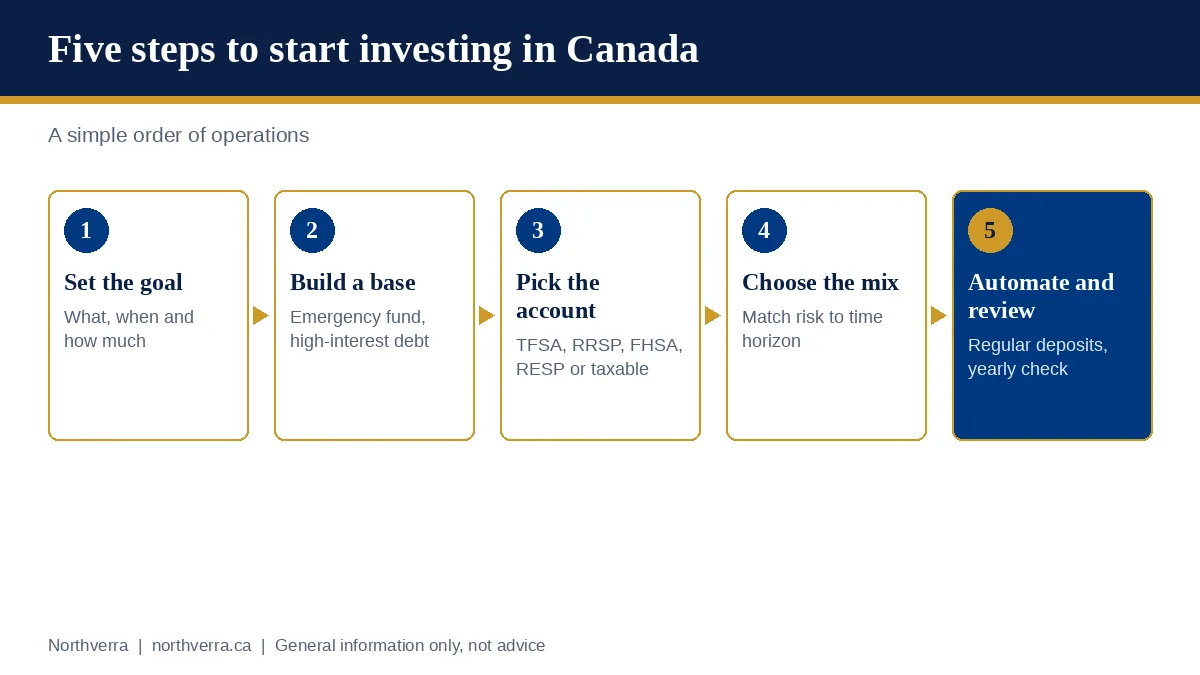
Short answer: To start investing in Canada, set a clear goal, build an emergency fund and deal with high-interest debt, choose the right account (such as a TFSA, RRSP, FHSA or RESP), pick a diversified mix that suits your timeline, then automate regular contributions and review once a year.
In this guide: Step 1: Decide what the money is for · Step 2: Build your safety net first · Step 3: Choose the right account · Step 4: Pick a mix that fits your timeline and comfort with risk · Step 5: Decide how you want to invest · Step 6: Automate and review · A starter checklist · Mistakes beginners often make · Understanding what you are buying · FAQ

If you are wondering how to start investing in Canada, the good news is that the first steps are more about planning than picking the perfect investment. The order you do things in often matters more than which fund you buy. This guide walks through a practical sequence that many people use, along with the questions to ask at each stage.
Step 1: Decide what the money is for
Investing without a goal is like driving without a destination. Write down each goal, roughly how much it will cost and when you will need the money. A down payment in four years, a child’s education in twelve years and retirement in twenty-five years each call for a different approach. Our guide to setting financial goals has a simple template.
Step 2: Build your safety net first
Before you invest for the long term, it usually makes sense to have:
- An emergency fund for unexpected costs or a drop in income, held somewhere easy to access.
- A plan for high-interest debt, such as credit card balances, because the interest you avoid by paying it down is often hard for investments to beat.
- Basic protection in place, such as appropriate insurance, so one event does not undo your plan.
Without this base, an unexpected bill can force you to sell investments at a bad time. See building an emergency fund in Canada and paying off debt vs investing.
Step 3: Choose the right account
Canada offers several registered accounts with tax advantages. Each has its own rules and contribution limits, so confirm the current details with the Canada Revenue Agency.
- TFSA: contributions are not deductible, but growth and withdrawals are generally tax-free. Flexible for many goals.
- RRSP: contributions may be deductible, growth is tax-deferred and withdrawals are taxed as income. Built mainly for retirement.
- FHSA: for eligible first-time home buyers, combining a deduction on the way in with tax-free qualifying withdrawals. See how the FHSA works.
- RESP: for a child’s education after high school, with government grants. See how an RESP works.
- Non-registered account: no contribution limits, but income and gains are generally taxable.
For a side-by-side view, read RRSP vs TFSA basics.
Step 4: Pick a mix that fits your timeline and comfort with risk
Once you know the goal and the account, choose what goes inside. The two biggest questions are how long until you need the money and how you would react to a drop in value. Short-term goals usually call for stable options such as savings or GICs. Long-term goals often include a larger share of stocks, usually through diversified funds. Our article on risk and time horizon explains the thinking, and the main types of investments describes each option.
Beginners often find one diversified fund, such as a balanced mutual fund or an all-in-one ETF, easier to manage than a collection of individual stocks. Read the Fund Facts or ETF Facts document before buying to understand the holdings, risks and fees.
Step 5: Decide how you want to invest
- Self-directed: you open an account with an online brokerage and make your own choices. Usually the lowest cost, but you carry all the decisions.
- Robo-advisor: an online service builds and rebalances a portfolio from your answers to a questionnaire.
- Working with an advisor: a licensed professional helps you build a plan and choose investments, usually for a fee or commission.
We compare these in robo-advisor vs financial advisor. Whichever you choose, check that the person or firm is registered with the appropriate regulator.
Step 6: Automate and review
Setting up an automatic contribution on payday turns investing into a habit rather than a monthly decision. This is the idea behind paying yourself first. Then review once a year, or when life changes, to check whether your goals, contributions and mix still fit.
Example (hypothetical): Marc, 27, has a $1,500 emergency fund goal left to finish and no credit card debt. He finishes the emergency fund first, then opens a TFSA and sets up an automatic $150 transfer each payday into a diversified balanced fund. These figures are for illustration only.
A starter checklist
- Goals written down with amounts and dates
- Emergency fund in place or under way
- High-interest debt being paid down
- Account type chosen for each goal
- Contribution room checked in CRA My Account
- Fund Facts or ETF Facts read and fees understood
- Automatic contributions set up
- Review date in the calendar
Mistakes beginners often make
- Waiting for the “perfect” moment to start, which rarely arrives.
- Copying a friend’s portfolio without the same goals or timeline.
- Checking the balance daily and reacting to every move.
- Over-contributing to a registered account and facing a penalty tax.
- Chasing tips on social media instead of following a plan.
Understanding what you are buying
Before you put money into any investment, make sure you can explain it in one or two sentences: what it holds, how it can make money, how it can lose money and what it costs each year. If you cannot, ask more questions or keep looking. For funds, the Fund Facts or ETF Facts document is a short summary required by Canadian securities regulators and is a good place to start. For GICs, read the terms on early redemption. A product that sounds complicated or promises unusually high returns with little risk is a reason to slow down, not to hurry.
Beginner investing terms, in plain language
| Term | What it means |
|---|---|
| Asset allocation | How your money is split between stocks, bonds and cash |
| Diversification | Spreading money across many investments to reduce risk |
| ETF | An exchange-traded fund that holds many investments and trades like a stock |
| Mutual fund | A pooled fund managed by professionals, bought and sold through a dealer or advisor |
| MER | The management expense ratio: a fund’s yearly cost, taken from its returns |
| Compound growth | Earning returns on your past returns over time |
| Registered account | An account with tax benefits, such as a TFSA, RRSP or FHSA |
| Rebalancing | Bringing your mix back to its target after markets move |
For the next step, see our guides to building a diversified portfolio and investment risk.
Your first year of investing: a simple plan
- Build or top up your emergency fund. See building an emergency fund.
- Open the account that fits your goal, often a TFSA for flexibility or an RRSP for retirement.
- Choose a simple, diversified investment, such as a broad index or asset allocation fund.
- Set up an automatic monthly contribution you can sustain.
- Leave it alone through normal ups and downs, and review once a year.
Next step
Not sure which account or mix fits your first goal? We can help you map out a starting plan.
More questions people ask
How much money do I need to start investing?
There is no fixed minimum. Many platforms and funds allow small purchases, and regular small contributions are a common way to begin. See investing with little money.
Should I invest or pay off debt first?
High-interest debt is usually tackled first, because the interest saved is a known benefit. Lower-interest debt, such as a mortgage, is more of a judgement call. Our debt vs investing guide explains the trade-off.
Is it safe to start investing right before a market drop?
Nobody can time the market reliably. Spreading purchases over time with regular contributions can reduce the impact of buying everything at a high point, though it does not guarantee a better result.
Can I lose money investing?
Yes. Except for insured deposits held within limits, investments can lose value. That is why matching risk to your timeline is so important.
What is the easiest way for a beginner to invest in Canada?
Many beginners start with a single diversified fund, such as an asset allocation ETF or a balanced mutual fund, inside a TFSA or RRSP, with automatic monthly contributions. A robo-advisor or advisor can set this up for you.
Should a beginner use a TFSA or an RRSP first?
It depends on your income now and later, and your goals. A TFSA is flexible and good for many goals; an RRSP gives a tax deduction that can be more valuable at higher incomes. See RRSP vs. TFSA.
How much should a beginner invest each month?
An amount you can keep up consistently matters more than a large starting sum. Even modest monthly contributions can grow meaningfully over many years. See how much to invest each month.
Do I need a financial advisor to start investing?
No, but some people find an advisor helpful for choosing an account and investment mix and staying on track. Others use a robo-advisor or do it themselves. See robo-advisor vs. financial advisor.
Last updated: October 11, 2026
Related guides
Have a question? Start a conversation
Tell us a little about your situation. We will reply within one business day.
By submitting this form you agree that Northverra may contact you about your enquiry. Please do not include account numbers, health details or other sensitive information. See our Privacy Policy.
Important information. Investing involves risk, including the possible loss of the amount invested. The value of investments can go down as well as up, and past performance does not guarantee future results. Nothing on this page is a recommendation or a promise of any return. Diversification and asset allocation do not ensure a profit or protect against loss. See our Disclosures.