
MORTGAGE QUESTIONS
Fixed vs variable mortgage: which is right for me?
Short answer: With a fixed mortgage, your interest rate stays the same for the whole term, so your payments are predictable. With a variable mortgage, your rate moves with your lender’s prime rate, so your payment or the share going to interest can change. Neither is always cheaper. The better choice depends on your budget, your comfort with change, your plans for the home and the penalties if you break the mortgage.
In this guide: How a fixed-rate mortgage works · How a variable-rate mortgage works · A side-by-side example · Questions to help you decide · Other options to consider · Qualifying is the same either way · Common mistakes to avoid · Fixed vs variable at renewal · FAQ

The fixed vs variable mortgage decision is one of the biggest choices you make when you buy or renew. People often look only at the starting rate, but the real differences show up later: in how your payment behaves, what happens if rates rise or fall, and what it costs to get out of the mortgage early. This guide goes deeper than our article on how mortgage interest rates work in Canada and focuses on how to choose.
How a fixed-rate mortgage works
A fixed rate is locked in for the term, commonly five years, although terms from one to ten years exist. Your regular payment stays the same, and you know exactly how much principal you will have paid by the end of the term. Fixed rates tend to follow bond yields rather than the Bank of Canada’s policy rate. The main trade-offs are that the rate may start higher than a variable rate and that breaking a fixed mortgage early can be costly, because the penalty is often the greater of three months’ interest or an interest rate differential.
How a variable-rate mortgage works
A variable rate is usually expressed as the lender’s prime rate plus or minus a set amount, such as prime minus 0.50%. When prime changes, your rate changes. For reference, the Bank of Canada reported a prime rate of 4.45% as of September 30, 2026, so a prime minus 0.50% mortgage would have been at 3.95% on that date. Lenders handle changes in two ways:
- Adjustable payments: your payment rises or falls with each rate change, keeping your amortization on track.
- Fixed payments: your payment stays the same, but the split between interest and principal changes. If rates rise far enough, almost all of the payment can go to interest, a point sometimes called the trigger rate, and the lender may require a higher payment or a lump sum.
Breaking a variable mortgage usually costs three months’ interest, which is often less than the penalty on a fixed mortgage. Our guide to mortgage prepayment penalties shows how both are calculated.
A side-by-side example
Example (hypothetical): Lena and Marc are each borrowing $400,000 over 25 years. Lena chooses a 5-year fixed rate and knows her payment for the full term. Marc chooses a variable rate with adjustable payments. When prime falls during the term, Marc’s payment drops and more goes to principal. When prime rises, his payment goes up. Over five years, either one could end up paying less interest; it depends entirely on how rates move, which no one can predict. Lena paid for certainty, and Marc accepted uncertainty in exchange for flexibility and a lower penalty. This is a hypothetical illustration, not a forecast.
Questions to help you decide
- Could your budget handle a payment increase of a few hundred dollars a month if rates rose?
- Would changing payments cause you stress, even if you could afford them?
- Is there a chance you will sell, move or refinance before the term ends?
- How close to your maximum approval are you borrowing?
- Do you have an emergency fund to absorb surprises?
If your budget is tight or certainty matters most, a fixed rate often fits better. If you have room in your budget, value a lower potential penalty and are comfortable with movement, a variable rate may suit you. You can model both in the mortgage calculator by testing a fixed rate you have been quoted against prime plus or minus a spread.
Other options to consider
- Hybrid or combination mortgages split the loan into fixed and variable portions.
- Shorter fixed terms, such as two or three years, can be a middle ground. See how to choose a mortgage term.
- Converting: many variable mortgages allow you to lock into a fixed rate during the term, usually at the lender’s then-current fixed rate for a term at least as long as what remains.
Qualifying is the same either way
The mortgage stress test applies to both fixed and variable mortgages. A lower variable rate leads to a lower qualifying rate, subject to the 5.25% floor, which can slightly increase the amount you qualify for. That should not be the only reason to choose variable.
Common mistakes to avoid
- Choosing on the starting rate alone.
- Ignoring how penalties differ if you might break the mortgage.
- Picking a variable rate with fixed payments without understanding the trigger rate.
- Assuming you will be able to “lock in” right before rates rise.
- Borrowing the maximum with a variable rate and no emergency fund.
Fixed vs variable at renewal
The fixed vs variable mortgage question comes back at every renewal, and your answer may change over time. A household that chose a fixed rate for certainty as first-time buyers may later have a larger cushion, a smaller balance and more comfort with a variable rate. The reverse is also common when a family’s budget tightens. Review the choice with fresh eyes each time, along with your term, amortization and prepayment goals, rather than renewing into the same product by default.
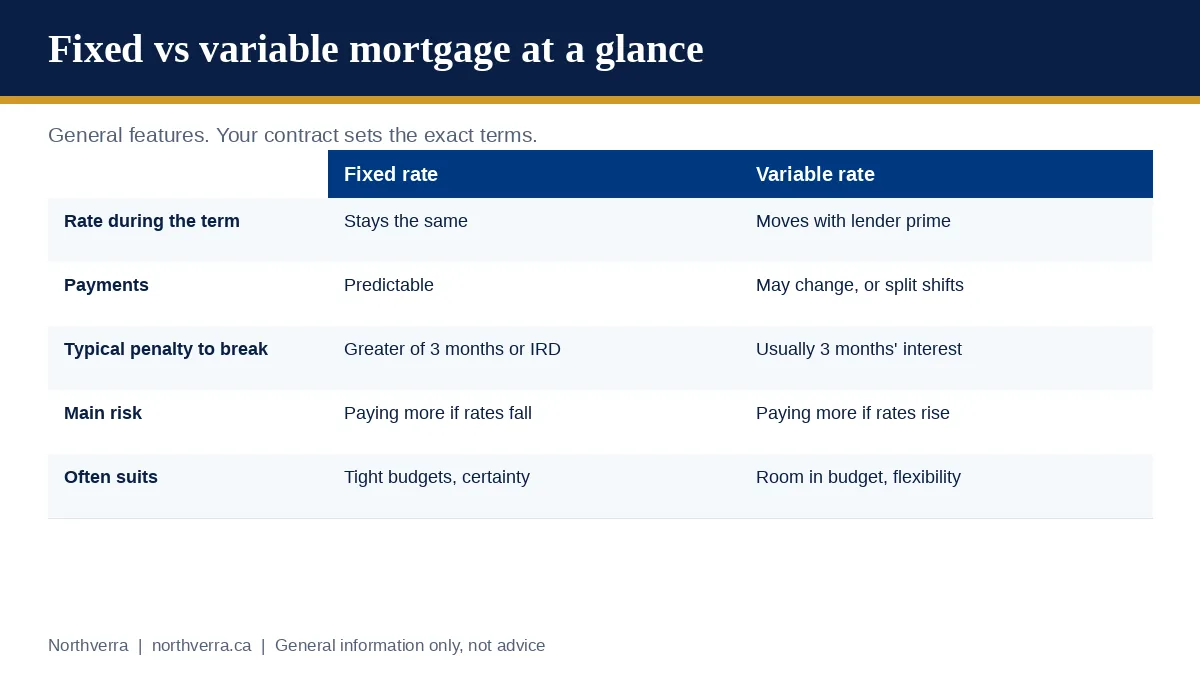
Fixed vs. variable at a glance
| Feature | Fixed rate | Variable rate |
|---|---|---|
| Interest rate | Locked for the term | Moves with the lender’s prime rate |
| Payments | Stay the same for the term | May change, or the amount going to principal may change |
| Budget certainty | High | Lower |
| Typical penalty to break | Often the greater of three months’ interest or an interest rate differential | Often three months’ interest |
| Often suits | Borrowers who want predictable payments | Borrowers who can handle payment changes and want flexibility |
Two kinds of variable mortgage
Variable mortgages come in two main forms. With an adjustable-rate mortgage, your payment changes when prime changes. With a fixed-payment variable mortgage, your payment stays the same, but the split between interest and principal changes. If rates rise far enough, more of the payment goes to interest and you may reach a trigger rate. Ask your lender which kind you are being offered. For how rates are set, see mortgage rates in Alberta.
Next step
If you are weighing a fixed or variable rate, we can model the payments, penalties and “what if” scenarios with you so the choice fits your budget and plans.
More questions people ask
Is a fixed or variable mortgage cheaper in Canada?
It depends on how rates move during your term. Sometimes variable rates have cost less over time and sometimes fixed rates have. No one can know in advance.
Can I switch from variable to fixed?
Many lenders allow you to convert a variable mortgage to a fixed rate during the term, often without a penalty, at the lender’s current fixed rate.
What is a trigger rate?
It is the rate at which a fixed variable-rate payment no longer covers the interest owed. Lenders then usually require a higher payment.
Does the Bank of Canada set my mortgage rate?
No. The Bank sets its policy rate, which influences prime and variable rates. Lenders set their own mortgage rates, and fixed rates are more influenced by bond yields.
Is fixed or variable better for first-time buyers?
Many first-time buyers choose fixed for predictable payments while they adjust to the costs of owning a home. A variable rate can suit buyers with room in their budget for payment changes. See first-time home buyers in Canada.
Which costs more to break, a fixed or variable mortgage?
Breaking a variable mortgage often costs three months’ interest. Breaking a fixed mortgage is often the greater of three months’ interest or an interest rate differential, which can be much larger. Check your own mortgage terms. See prepayment penalties.
Can my variable mortgage payment change?
With an adjustable-rate mortgage, yes, your payment changes when prime changes. With a fixed-payment variable mortgage, the payment stays the same but less may go to principal when rates rise.
How long should my fixed term be?
Five years is common, but shorter or longer terms can suit different plans, such as an expected move or a desire for long-term certainty. See how to choose a mortgage term.
Last updated: October 11, 2026
Related guides
Have a question? Start a conversation
Tell us a little about your situation. We will reply within one business day.
By submitting this form you agree that Northverra may contact you about your enquiry. Please do not include account numbers, health details or other sensitive information. See our Privacy Policy.
Important information. Mortgage approval, interest rates, terms and eligibility depend on the lender, your financial profile, the property and current market conditions, and are not guaranteed. Mortgage products and rates change. Nothing on this page is a commitment to lend or a quote of any rate. See our Disclosures.