
MORTGAGE GUIDE
First-Time Home Buyers in Canada
Short answer: First-time home buyers in Canada usually need a down payment of at least 5% on lower-priced homes, enough income to pass the mortgage stress test, and savings for closing costs. Programs such as the First Home Savings Account and the RRSP Home Buyers’ Plan can help you save. Getting pre-approved before you shop shows what you can afford.
Quick facts
- The minimum down payment starts at 5% of the purchase price for lower-priced homes.
- With less than 20% down, you need mortgage default insurance, such as CMHC insurance.
- Eligible first-time buyers can choose an insured amortization of up to 30 years.
- The FHSA lets eligible first-time buyers save tax-free, with an annual limit of $8,000 and a lifetime limit of $40,000, according to the CRA.
- The Home Buyers’ Plan lets eligible buyers withdraw up to $60,000 from their RRSPs, according to the CRA.
In this guide: The first-time home buyer journey · Step 1: Work out your budget · Step 2: Check and strengthen your credit · Step 3: Save your down payment · Step 4: Understand mortgage insurance · Step 5: Get pre-approved · Step 6: Shop and make an offer · Step 7: Prepare for closing · Choosing your first mortgage · Common first-time buyer mistakes · FAQ

Buying your first home is one of the biggest financial steps you will take. The process can feel complicated, but it follows a clear order. This guide walks through each step for first-time home buyers in Canada, with notes for buyers in Alberta. For a printable list of tasks, see our first-time home buyer checklist for Alberta.
The first-time home buyer journey
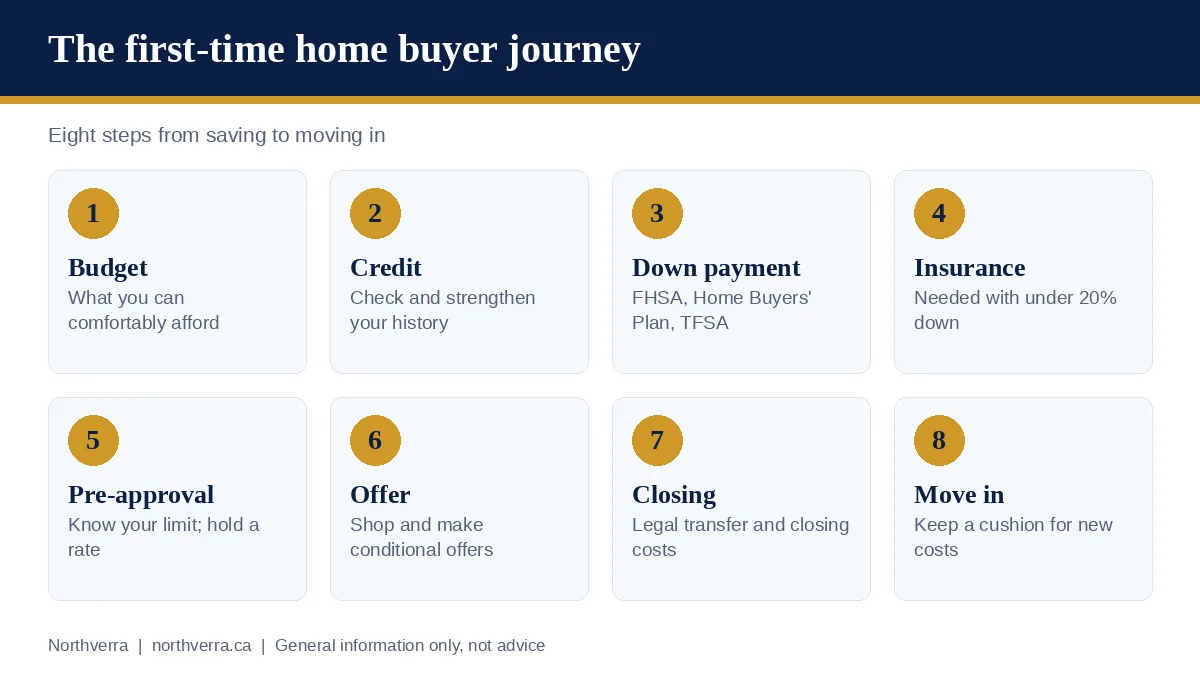
Step 1: Work out your budget
Start with what you can comfortably afford each month, not the largest mortgage a lender might approve. Include property taxes, utilities, home insurance, maintenance and condo fees if they apply. Our guide to how much mortgage you can afford explains how lenders look at your income and debts.
Step 2: Check and strengthen your credit
Lenders review your credit history to decide whether to approve you and at what rate. Paying bills on time, keeping credit card balances low and avoiding new debt before you apply can help. See understanding your credit score.
Step 3: Save your down payment
In Canada, the minimum down payment starts at 5% for lower-priced homes. Several tools can help you save faster:
| Program | What it does | Learn more |
|---|---|---|
| First Home Savings Account (FHSA) | Tax-deductible contributions and tax-free withdrawals for a qualifying first home | FHSA guide |
| RRSP Home Buyers’ Plan (HBP) | Withdraw up to $60,000 from your RRSPs, repaid over time | Home Buyers’ Plan guide |
| TFSA | Tax-free savings you can withdraw at any time | RRSP vs. TFSA |
| First-Time Home Buyers’ Tax Credit | A federal non-refundable tax credit in the year you buy | Check the CRA website |
| Gifts from family | Many lenders accept gifted down payments with a signed gift letter | Ask your lender about requirements |
Step 4: Understand mortgage insurance
If your down payment is less than 20%, your mortgage must be insured against default, for example through CMHC. The premium is usually added to your mortgage. Insured mortgages generally have a maximum amortization of 25 years, or up to 30 years for eligible first-time buyers. See CMHC mortgage insurance.
Step 5: Get pre-approved
A pre-approval shows how much a lender is willing to lend you, based on your income, debts, credit and down payment, and can include a rate hold. It also helps you shop with confidence. You will need to pass the stress test, which checks that you could afford payments at a higher qualifying rate. See mortgage pre-approval and the stress test.
Step 6: Shop and make an offer
Work with a real estate professional if you choose, view homes within your budget, and make offers with conditions that protect you, such as financing and inspection conditions. Once your offer is accepted, your lender will confirm the details of the property.
Step 7: Prepare for closing
Closing is the day ownership transfers to you. Before then, your lawyer will handle the legal transfer and mortgage registration. Budget for closing costs, which in Alberta include Land Titles registration fees rather than a land transfer tax. See closing costs in Alberta.
Example (hypothetical): Chris and Taylor, both first-time buyers in Calgary, saved in their FHSAs for three years and plan to add Home Buyers’ Plan withdrawals from their RRSPs. With 10% down, they will need an insured mortgage and are considering a 30-year amortization to keep payments manageable. They get pre-approved with a rate hold before they start viewing homes.
Choosing your first mortgage
Your first mortgage involves several choices: fixed or variable, the term length, the amortization and the prepayment options. Our guides to fixed vs variable mortgages and choosing a mortgage term explain the trade-offs.
Common first-time buyer mistakes
- Shopping before getting pre-approved.
- Spending the whole pre-approved amount without leaving a cushion.
- Forgetting closing costs and moving expenses.
- Taking on new debt before closing.
- Choosing a mortgage on rate alone without checking penalties and flexibility.
Key takeaways
- Know your budget before you start looking at homes.
- Combine savings tools like the FHSA, Home Buyers’ Plan and TFSA to build your down payment.
- Get pre-approved so you know what you can borrow and can hold a rate.
- Budget for closing costs and moving expenses, not just the down payment.
- Keep your finances stable between pre-approval and closing.
Who this guide is for
- Canadians buying their first home.
- Albertans who have not owned a home in the past several years and may qualify as first-time buyers.
- Couples where one partner is a first-time buyer.
- Renters starting to save for a down payment.
Questions to ask a mortgage professional
- How much can I afford, and what would my payments be?
- Which savings programs am I eligible for?
- What would my mortgage insurance premium be?
- What closing costs should I budget for?
- Should I choose a 25-year or 30-year amortization?
Frequently asked questions
Who counts as a first-time home buyer in Canada?
The definition depends on the program. For several federal programs, you can qualify if you have not lived in a home owned by you or your spouse or common-law partner in the current year or the previous four calendar years. Check the CRA’s rules for each program.
How much do I need for a down payment?
At least 5% of the first $500,000 of the purchase price, with higher minimums above that amount, and 20% for some higher-priced homes. Our guide to the minimum down payment explains the tiers.
Can I use both the FHSA and the Home Buyers’ Plan?
Yes. Eligible first-time buyers can use both for the same home purchase, which can significantly increase the money available for a down payment. Each has its own rules.
What is the First-Time Home Buyers’ Tax Credit?
It is a federal non-refundable tax credit that eligible first-time buyers can claim on their tax return in the year they buy a qualifying home. Check the CRA website for the current amount and eligibility.
How long does it take to buy a first home?
Saving a down payment can take years. Once you are ready to buy, the process from pre-approval to closing often takes a few months, depending on how long you shop and the closing date you agree on.
What closing costs should first-time buyers in Alberta expect?
Common costs include legal fees, Land Titles registration fees, title insurance, property tax adjustments and moving costs. Alberta has no land transfer tax, but costs still add up. See closing costs in Alberta.
Should I buy a condo or a house as my first home?
It depends on your budget, lifestyle and plans. Condos can cost less to buy but come with monthly fees and building rules. Houses usually cost more but offer more control. Review condo documents carefully before buying.
What should I avoid before closing?
Avoid taking on new debt, changing jobs if you can help it, missing payments or making large unexplained deposits. Lenders may recheck your finances before closing.
Last updated: October 11, 2026
Related guides
- First-time home buyer checklist for Alberta
- How much mortgage can I afford in Canada?
- What is the minimum down payment in Canada?
- How does the FHSA work?
- How does the RRSP Home Buyers’ Plan work?
- All mortgage questions, answered
Talk it through with us
Every situation is different. If you would like to talk about how this applies to you, we are happy to walk through your questions with no obligation.
Have a question? Start a conversation
Tell us a little about your situation. We will reply within one business day.
By submitting this form you agree that Northverra may contact you about your enquiry. Please do not include account numbers, health details or other sensitive information. See our Privacy Policy.
Important information. Mortgage approval, interest rates, terms and eligibility depend on the lender, your financial profile, the property and current market conditions, and are not guaranteed. Mortgage products and rates change. Nothing on this page is a commitment to lend or a quote of any rate. See our Disclosures.
Important information. The information on this page is general in nature, is provided for educational purposes only, and is not personalized financial, insurance, legal, tax or mortgage advice. Your circumstances are unique. Please speak with a properly licensed professional before making decisions. See our Disclosures.