
LIFE INSURANCE QUESTIONS
How much does life insurance cost in Alberta?
Short answer: It depends mainly on your age, health, the amount of coverage and the type of policy. As an illustration from published examples, a healthy 30-year-old non-smoker may see roughly $20 to $45 a month for $500,000 of term coverage, depending on the term length, gender and insurer. Permanent insurance costs much more for the same amount.
In this guide: Example premiums · What affects the price · Term vs permanent cost · Ways to keep premiums manageable · Is Alberta different? · How insurers decide your price · Why two quotes for the same person can differ · What a permanent policy costs, and why · A checklist before you buy · FAQ
Example premiums for term insurance
Published examples give a sense of scale, although your own quote will differ. For a healthy, non-smoking 30-year-old buying $500,000 of term coverage, insurers and comparison sites have shown figures of about $20 to $30 a month for a 20-year term and about $31 to $45 a month for a 30-year term. Women often see slightly lower premiums than men at the same age.
These numbers are examples from public sources in 2026 and are not a quote or an offer. Premiums change, and insurers set their own rates.
What affects the price
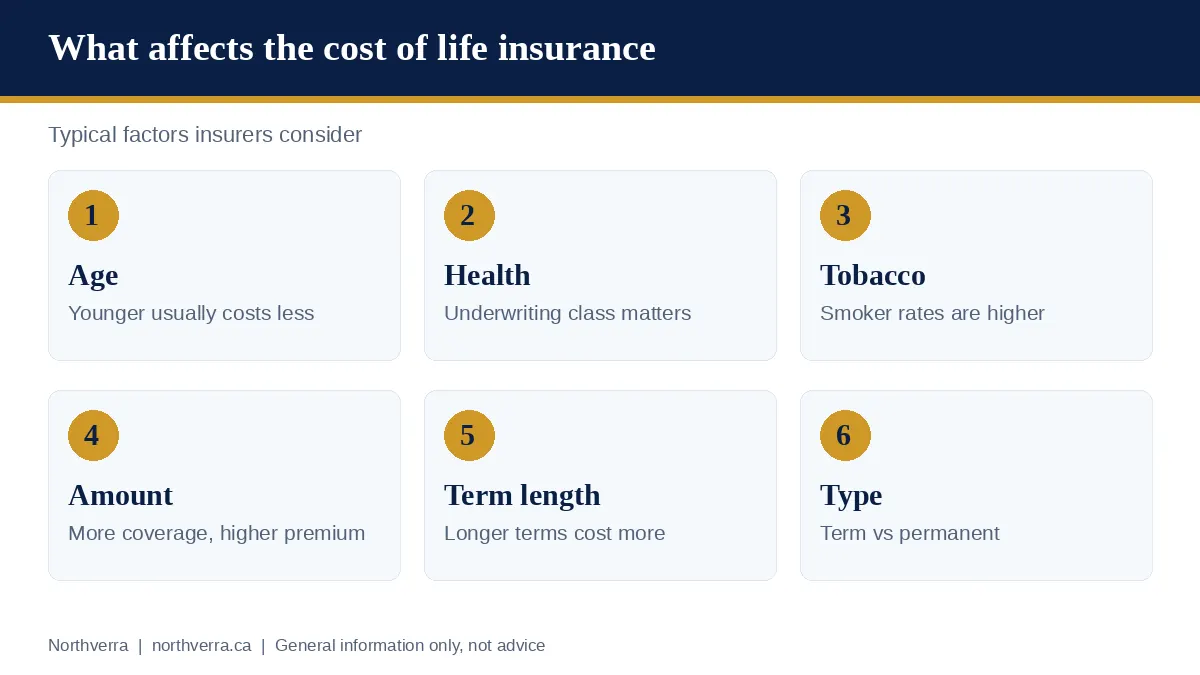
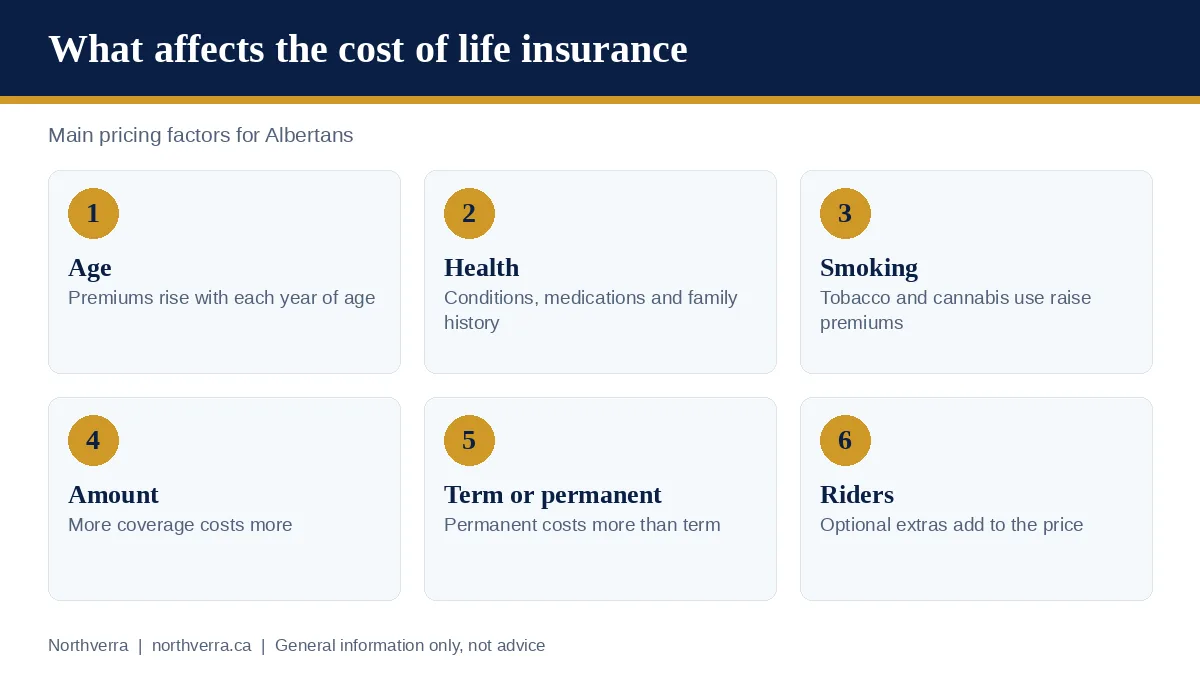
- Age: premiums generally rise with age, so earlier is usually cheaper
- Health: insurers place applicants in health classes after underwriting
- Tobacco and nicotine use: smoker rates are substantially higher
- Coverage amount: more coverage costs more, though not always in a straight line
- Term length: longer terms cost more per month because the insurer covers you for longer
- Type of policy: term, whole life and universal life are priced very differently
- Riders and add-ons: options like critical illness or waiver of premium add to the cost
Term versus permanent: a big price gap
Term insurance is generally the least expensive way to get a large amount of coverage. Permanent insurance, such as whole life or universal life, costs considerably more for the same face amount because it is designed to last a lifetime and may include a cash value. The extra cost is not necessarily bad value, but it should match a purpose. Read more in our comparison of term vs. whole life.
Ways to keep premiums manageable
- Buy while you are younger and healthier
- Choose a term length that matches your need, such as the years left on a mortgage
- Ask about the premium difference between payment frequencies
- Compare the insurer’s renewal and conversion options, not only the first-year price
- Review your coverage amount using our guide on how much you may need
Is Alberta different?
Term life insurance rates are generally similar across Canada, and several providers note that price does not vary by province. Your age, health and choices matter far more than where you live. Alberta’s Insurance Council licenses insurance agents and offers consumer resources if you want to confirm that an advisor is licensed.
Coverage options available to Albertans
| Option | What it is | Often used for |
|---|---|---|
| Term life | Coverage for a set period, such as 10, 20 or 30 years | Income replacement and mortgage years |
| Whole life | Permanent coverage with fixed premiums and guaranteed values | Lifelong needs and estate planning |
| Universal life | Permanent coverage with flexible premiums and an investment account | Lifelong needs with flexibility |
| Group life at work | Coverage through an employer plan | A base amount while you work there |
| Mortgage insurance from a lender | Coverage tied to your mortgage balance | Paying off the mortgage |
| Simplified or guaranteed issue | Fewer or no medical questions, usually at a higher cost | People who have trouble qualifying for regular coverage |
Learn more about each type in our guides to term life insurance in Canada and whole life vs. universal life insurance.
Choosing coverage and options in Alberta: practical steps
- Work out how much coverage you need and for how long. See how much life insurance you need.
- Decide whether your need is temporary, lifelong or both.
- Check what you already have through work or your mortgage.
- Compare quotes for the same amount, term and riders from more than one insurer.
- Apply while you are healthy, and answer health questions accurately.
- Review your coverage when your family, home or income changes.
Next step
Tell us your age and goals and we can explain what affects your price.
How insurers decide your price
When you apply, the insurer’s underwriters estimate how likely a claim is during the policy. They place you in a rating class, and each class has its own price. Classes are often described as preferred, standard and rated, and the best classes are reserved for people with strong health histories.
- Preferred or best rates: excellent health measures and a clean family history
- Standard rates: typical health for your age
- Rated or table-rated: a higher premium because of a condition or risk
- Smoker and non-smoker classes: separate pricing, and smokers pay considerably more
Different insurers weigh the same facts differently, so the same person can receive quite different quotes. That is why comparing several is worth the effort.
Why two quotes for the same person can differ
- Insurers use different underwriting guidelines for conditions such as high blood pressure, or for tobacco use
- Some price younger ages more aggressively, others older ages
- Policy features differ, including renewal rates and conversion rights
- Some quotes include riders, such as waiver of premium or critical illness, that others do not
- Rounding and age-last-birthday versus age-nearest-birthday rules can change the number
When you compare, compare like with like: the same amount, the same term, the same rating class and the same riders.
What a permanent policy costs, and why
Permanent insurance costs much more per month than term for the same death benefit. That is not an error. The insurer is promising to pay a benefit no matter when you die, and part of the premium also builds cash value. A permanent policy may make sense for a lifelong need, but it should not be bought only because it sounds more complete. Read about cash value and universal life to see where the money goes.
A checklist before you buy
- Decide the amount using our guide on how much life insurance you may need
- Choose a term length that matches the need
- Get at least two or three quotes on the same basis
- Ask about renewal premiums, conversion rights and the age limit for conversion
- Check the premium payment options, such as monthly or annual, and any fees
- Ask about the free-look period, which often gives you a short window to cancel and receive a refund, and confirm the details in your contract
- Be fully honest in the application, because errors can affect a claim
Questions about cost
Is life insurance cheaper if I buy it young?
Usually, yes. Premiums are based on age and health when you buy, and a level term premium stays the same through the term. Waiting can raise the price, and health changes could limit your options.
Do I pay more if I have a dangerous hobby or job?
Some activities, such as flying, scuba diving or certain occupations, may increase premiums or lead to exclusions. Tell the insurer about them.
Can I deduct life insurance premiums from my taxes?
In general, premiums on personal life insurance are not tax-deductible in Canada. Business situations can differ, so ask an accountant.
What happens if I miss a payment?
Policies usually have a grace period, often around 30 days, but check your contract. If a policy lapses, you may need to reapply or apply for reinstatement, which can involve new health questions.
Does it cost less if my spouse and I buy together?
Some insurers offer joint or discount options. Individual policies are often more flexible, so compare both before choosing.
What types of life insurance can I buy in Alberta?
Albertans can buy term life, permanent coverage such as whole life and universal life, group coverage through work, mortgage insurance from a lender, and simplified or guaranteed issue policies. Each has a different cost and purpose.
Is group life insurance at work enough coverage?
It is a helpful base, but it is often one or two times your salary and usually ends or changes when you leave the job. Many families with a mortgage and children need more. See employer versus private coverage.
Can I get life insurance without a medical exam in Alberta?
Yes. Many insurers offer coverage based on health questions alone for smaller amounts, and simplified or guaranteed issue policies ask few or no medical questions. These options usually cost more for the same coverage.
Last updated: October 11, 2026
Related guides
Have a question? Start a conversation
Tell us a little about your situation. We will reply within one business day.
By submitting this form you agree that Northverra may contact you about your enquiry. Please do not include account numbers, health details or other sensitive information. See our Privacy Policy.
Important information. Life insurance products are subject to underwriting, eligibility, exclusions, limitations and the terms of the policy contract. Coverage, premiums and availability depend on your age, health, lifestyle and other factors. Nothing on this page is an offer of insurance or a guarantee of coverage or price. See our Disclosures.