
MORTGAGE FINANCING
Mortgage Financing in Calgary and Alberta
Find financing solutions that fit your homeownership and financial goals. Northverra helps you understand your options, from your first purchase to a refinance, a renewal or an investment property.
POSTED MORTGAGE RATES
Mortgage Rates
Here are the posted rates one Canadian mortgage brokerage advertised for Alberta. They are third-party market rates, not Northverra’s rates. Tap a rate to see your estimated payment in the calculator below.
Rates posted Last updated
| Term | Type | Rate | Date posted | Calculator |
|---|---|---|---|---|
| 1-year | Fixed | 4.54%* | ||
| 2-year | Fixed | 4.39% | ||
| 3-year | Fixed | 4.49%* | ||
| 4-year | Fixed | 4.44% | ||
| 5-year | Fixed | 4.59%* | ||
| 5-year | Variable | 3.49% | ||
| 5-year open | Open† | 4.20%‡ | ||
| 6-month | Fixed | 2.49%‡ | ||
| 2-year (40-year amortization) | Fixed | 5.54% |
* The source describes these rates as available for high-ratio (insured) purchases, with geographical restrictions, new business only and a minimum mortgage amount. It also notes that extra premiums may apply to rentals, extended amortizations, non-standard properties and alternative lending, and that equity and credit affect the final rate. Ranges shown by the source: 3-year fixed 4.49% to 4.99%; 5-year fixed 4.59% to 4.99%; 5-year variable up to 5.00%. † The source does not say whether its open rate is fixed or variable. ‡ Short-term/open rate: payment shown uses the amortization you choose.
Mortgage rates are subject to change without notice. Rates shown were posted by True North Mortgage on Oct 11, 2026 and are not an offer or a quote from Northverra. Your actual rate depends on your credit, down payment, property, lender and mortgage type. Contact us for options based on your situation. Source: True North Mortgage Alberta rates page.
Last updated: October 12, 2026
MORTGAGE CALCULATOR
Mortgage Payment Calculator for Canada
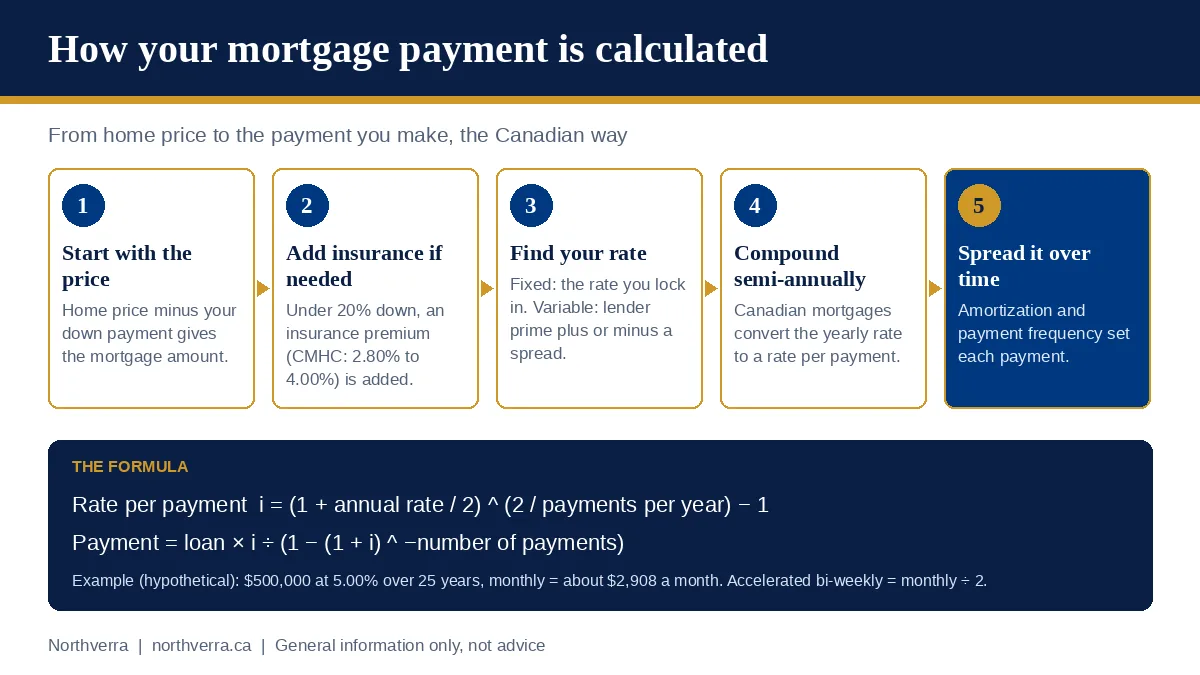
Estimate your mortgage payment the way Canadian lenders work it out: semi-annual compounding, mortgage insurance when you put less than 20% down, and every common payment frequency, including accelerated bi-weekly and weekly. Variable-rate estimates start from the Bank of Canada prime rate, and you can test any fixed rate you have been quoted. Curious what moves rates? Read how mortgage interest rates work in Canada. Still saving for a down payment? See how a First Home Savings Account (FHSA) works. Already own your home? Choose Refinance (no down payment) at the top of the calculator to estimate a new mortgage from your home’s value and what you still owe.
Reference rateBank of Canada prime rate: 4.45% as of · Source: Bank of Canada
Published by the Bank of Canada (series V80691311, “Prime rate”). Each lender sets its own prime rate, and the rate you are offered depends on your lender, product and situation. It is a reference point, not a quote.
- Your mortgage
- Mortgage amount (price minus down payment)
- –
- CMHC insurance premium (estimate)
- –
- Total mortgage (premium added)
- –
- New mortgage amount (balance + cash out + costs)
- –
- Loan-to-value (new amount ÷ home value)
- –
- Most you could refinance at 80% of value
- –
- Estimated equity you could access
- –
- Payment at the 80% limit
- –
- Mortgage default insurance
- Not available
- Over your 5-year term
- Interest paid
- –
- Principal paid
- –
- Balance at end of term
- –
- Over the full amortization
- Total interest (if the rate never changed)
- –
- Time to pay off
- –
Estimate only. Not a quote or an approval. Rates, rules and eligibility vary by lender and situation.
Principal and interest paid each year
Year-by-year amortization summary
| Year | Interest | Principal | Year-end balance |
|---|
- How it is calculated: interest is compounded semi-annually, not in advance, as is standard for Canadian fixed-rate mortgages. The same convention is used here for variable rates (some lenders compound variable-rate mortgages monthly, which changes the payment slightly). Rates are assumed to stay the same for the whole amortization; payments are rounded to the cent.
- Mortgage insurance: with less than 20% down, the estimate adds a premium using CMHC’s published premium rates on the total loan: 4.00% (5% to 9.99% down), 3.10% (10% to 14.99%), 2.80% (15% to 19.99%), plus 0.20% for amortizations over 25 years. Other insurers and non-traditional down payments may differ, and some provinces charge sales tax on the premium.
- Minimum down payment: 5% of the first $500,000 and 10% of the portion above $500,000; homes priced at $1.5 million or more need at least 20% down because mortgage insurance is not available (CMHC).
- Stress test: lenders check that you could still afford payments at a higher qualifying rate. For uninsured mortgages at federally regulated lenders, OSFI’s minimum qualifying rate is the greater of your contract rate plus 2% or 5.25%. The qualifying payment above is shown for information only; lenders also look at your income, debts and credit.
- Refinance: in Refinance mode the new mortgage is your current balance plus any cash you take out and any costs you roll in; no down payment is involved. Most lenders limit a refinance to 80% of your home’s value, and refinances are not eligible for mortgage default insurance. Rules and rates vary by lender.
- Not included: property tax, heating, condo fees, home insurance, closing costs and any life or disability coverage on the mortgage.
Estimate only. This calculator provides estimates for illustration only, not a mortgage offer, approval or financial advice. Actual rates, payments and eligibility depend on your lender and situation.
Questions about your numbers? Send us a message using the form at the bottom of this page.
Refinancing: how the estimate works
When you refinance, you replace the mortgage you have now with a new one instead of buying a home, so there is no down payment; the equity you have built up does that job. In Refinance mode the calculator adds your current balance, any cash you want to take out and any costs you choose to roll in, compares that total with your home’s value (the loan-to-value ratio) and checks it against the 80% limit most lenders use. The payment is worked out with the same semi-annual compounding as the purchase estimate. Breaking a mortgage before its term ends can mean a prepayment penalty, so it helps to know that figure before you compare. Rules and rates vary by lender.
How much of my home’s value can I borrow when I refinance?
Most lenders cap a refinance at 80% of the home’s appraised value, and that cap includes what you still owe. On a home worth $600,000, the new mortgage would usually top out around $480,000; with a $350,000 balance, that leaves roughly $130,000 of equity you might be able to access, before costs. Lenders also look at your income, debts and credit, so the amount available to you may be lower.
Do I need a down payment or mortgage insurance to refinance?
No down payment is needed, because you already own the home and your equity stays in it. Refinances are not eligible for mortgage default insurance, which is one reason lenders keep the new mortgage at or below 80% of the home’s value.
What costs come with refinancing?
Common costs include a prepayment penalty if you leave your current term early, plus legal, appraisal and discharge or registration fees. Some homeowners add these to the new mortgage, which you can test in the calculator, but that means paying interest on them over time. Ask your lender for a written penalty estimate before you decide.
BUYING A HOME
Home Purchase Financing
Buying a home is a big step. We help you understand how much you may be able to borrow, what the monthly commitment could look like and what to prepare before you start looking.
- Pre-approval and budgeting basics
- Down payment considerations
- Closing costs to plan for
- How different mortgage types compare

EXISTING HOMEOWNERS
Mortgage Refinancing, Renewal and Debt Consolidation
Your needs change after you buy. We help you think through three common situations.
Mortgage Refinancing
Replacing your current mortgage with a new one, for example to change your term or access equity. Consider penalties and fees.
Renewal Considerations
Reviewing your options as your term ends, rather than automatically signing the renewal offer.
Debt Consolidation
Using home equity to combine higher-interest debts. It may reduce monthly payments but can increase total cost over time.

GROWING YOUR HOLDINGS
Investment Property Financing
Financing a rental or investment property often follows different rules than financing the home you live in. Lenders may ask for a larger down payment and look at rental income differently.
We can help you understand the financing side. Property investing carries risk, and you should consider tax and legal advice before buying.
THE FULL PICTURE
Understanding Mortgage Options
Comparing mortgages is about more than a rate. Features can affect what you pay and how much flexibility you have.
Fixed or variable
Stability versus potential movement in payments.
Term and amortization
The length of your agreement versus how long you take to pay off the loan.
Prepayment features
Whether and how you can pay extra without penalty.
Penalties and portability
What leaving early or moving could cost.
GETTING READY
Mortgage Qualification
Lenders in Canada generally apply a stress test and look at your debt service ratios, so the amount you qualify for may be different from what you expect. Building savings for your down payment? See how our investment planning approach works.
- Proof of income and employment
- Down payment and where it comes from
- Credit history and existing debts
- Details of the property you want to buy or refinance
Qualification criteria change over time and vary by lender. We help you understand where you stand before you apply.
QUESTIONS
Mortgage Financing: Frequently Asked Questions
What do lenders look at when I apply for a mortgage?
Lenders typically look at your income and employment, credit history, existing debts, down payment, and the property itself. Each lender has its own criteria.
How much down payment do I need in Canada?
Minimum down payment rules in Canada depend on the price of the home, and lower down payments generally require mortgage default insurance. Rules change, so confirm current requirements before you plan.
What is the difference between a fixed and a variable rate?
A fixed rate stays the same for the term. A variable rate moves with the lender’s prime rate. Each has trade-offs, and which suits you depends on your budget, risk comfort and plans.
When should I think about my renewal?
Many borrowers begin reviewing options several months before the renewal date. Early review gives you time to compare choices instead of accepting the first offer.
Can you guarantee the lowest rate?
No. Rates differ by lender, product and borrower, and they change often. We help you understand your options and compare them in context, including features and flexibility, not only the rate.
Can I refinance to consolidate debt?
Sometimes. Refinancing to consolidate debt can lower monthly payments but may cost more over time, and there can be fees and penalties. It is important to compare the full cost before deciding.
Discuss your mortgage options
Tell us what you are planning. We will explain your choices clearly and without pressure.
Related guides
- Mortgage questions, answered: our full mortgage FAQ
- How much mortgage can I afford in Canada?
- What is the minimum down payment in Canada?
- Fixed vs variable mortgage: which is right for me?
- What is the mortgage stress test?
- What is CMHC mortgage insurance?
- When does it make sense to refinance a mortgage?
- First-time home buyer checklist for Alberta
- Mortgage renewal: what to review before you sign
- Mortgage rates in Alberta: how they work
- First-time home buyers in Canada: a step-by-step guide
- Using home equity to consolidate debt
- HELOC vs. mortgage refinance: which fits you?
- How life insurance can protect your mortgage
Have a question? Start a conversation
Tell us a little about your situation. We will reply within one business day.
By submitting this form you agree that Northverra may contact you about your enquiry. Please do not include account numbers, health details or other sensitive information. See our Privacy Policy.
Important information. Mortgage approval, interest rates, terms and eligibility depend on the lender, your financial profile, the property and current market conditions, and are not guaranteed. Mortgage products and rates change. Nothing on this page is a commitment to lend or a quote of any rate. See our Disclosures.